1. Introduction
Antibodies or immunoglobulins are the defense proteins produced in mammals. Immunoglobulins have been divided into five major classes on the basis of their physical, chemical and immunological properties. The five main classes of immunoglobulins are IgA, IgD, IgG, IgE and IgM. Immunoglobulins are composed of two heavy chains and two light chains (Figure 41.1). Each class of Ig has its own class of H (heavy) chain, termed α, δ, ε, γ, μ respectively. Each Ig also has two light chains which are either κ or λ. The main antibody found in secretions, IgA has a more complicated structure. In secretions, IgA exists as a dimer of two IgA molecules joined by a J chain and a secretory component. The two antigen binding sites in the antibody molecule are formed from the variable regions of the light and heavy chains. Since these variable regions are responsible for the antigen binding, simpler, smaller molecules that still bind antigens can be produced. Single chain variable fragment (ScFv) antibodies are produced from synthetic genes made by fusing the sequence for light and heavy chain variable regions. ScFv antibodies are the commonly used most successful antibodies.
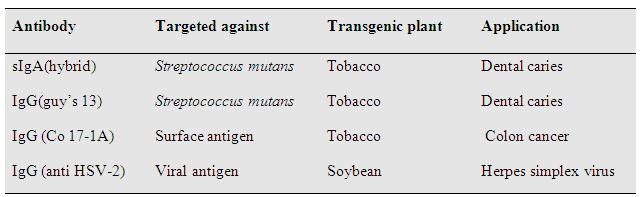
The use of plants for commercial production of antibodies, referred to as plantibodies, is a new approach in biotechnology. The first successful functional antibody produced in plant was mouse immunoglobulin IgG1. For this two transgenic tobacco plants, one synthesizing heavy γ chain and the other light κ chain, are crossed to generate progeny that can produce an assembled functional antibody. Some examples of antibodies produced in transgenic plants were given in Table 41.1.
Table 41.1: Antibodies produced in transgenic plants