8.2. Hairy roots are genetically stable
Hairy roots are genetically stable consequently they exhibit biochemical stability that leads to stable and high-level production of secondary metabolites. Hairy root cultures apparently retain diploidy in all species so far studied. The stable production of hairy root cultures is dependent on the maintenance of organized states. The factors which promote disorganization and callus formation depress secondary metabolite production. The productivity of hairy root cultures is stable over many generations in contrast to disorganized cell cultures. This stability is reflected in both the growth rate and the level pattern of secondary metabolite production.
9. Application of hairy root cultures
9.1. Production of secondary metabolites
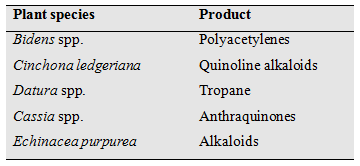
The hairy root system is stable and highly productive under hormone-free culture conditions. The fast growth, low doubling time, easy maintenance, and ability to synthesize a range of chemical compounds of hairy root cultures gives additional advantages as continuous sources for the production of plant secondary metabolites. Usually root cultures require an exogenous phytohormone supply and grow very gradually, resulting in the poor or insignificant synthesis of secondary metabolites. Hairy roots are also a valuable source of photochemical that is useful as pharmaceuticals, cosmetics, and food additives. These roots synthesize more than a single metabolite; prove economical for commercial production purposes. Many medicinal plants have been transformed successfully by A. rhizogenes and the hairy roots induced show a relatively high productivity of secondary metabolites, which are important pharmaceutical products. Sevon has summarized the most important alkaloids produced by hairy roots, including Atropa belladonna L., Catharanthus trichophyllus L., and Datura candida L.
Metabolic engineering offers new perspectives for improving the production of secondary metabolites by the over expression of single genes. This approach may lead to an increase of some enzymes involved in metabolism and, consequently, results in the accumulation of the target products. This method utilizes the foreign genes that encode enzyme activities not normally present in a plant. This may cause the modification of plant metabolic pathways. Two direct repeats of a bacterial lysine decarboxylase gene, expressed in the hairy roots of Nicotiana tabacum, have markedly increased the production of cadaverine and anabasine (Feckeret al . 1993). The production of anthraquinone and alizarin in hairy roots of Rubia peregrina L. was enhanced by the introduction of isochorismate synthase. Catharanthus roseus hairy roots harboring hamster 3-hydroxy-3-methylglutaryl coenzyme A reductase (HMGR) cDNA without the membrane-binding domain were found to produce more ajmalicine and catharanthine or serpentine and campesterol than the control.
9.2. Production of compounds not found in untransformed roots
Transformation may affect the metabolic pathway and produce new compounds that cannot be produced normally in untransformed roots. For example, the transformed hairy roots of Scutellaria baicalensis Georgi accumulated glucoside conjugates of flavonoids instead of the glucose conjugates accumulated in untransformed roots.
9.3. Changing composition of metabolites
Bavage et al. (1997) reported the expression of an Antirrhinum dihydroflavonol reductase gene which resulted in changes in condensed tannin structure and its accumulation in root cultures of L. corniculatus. The analysis of selected root culture lines indicated the alteration of monomer levels during growth and development without changes in composition.
Table 2.1: Pharmaceutical products produced using hairy root cultures