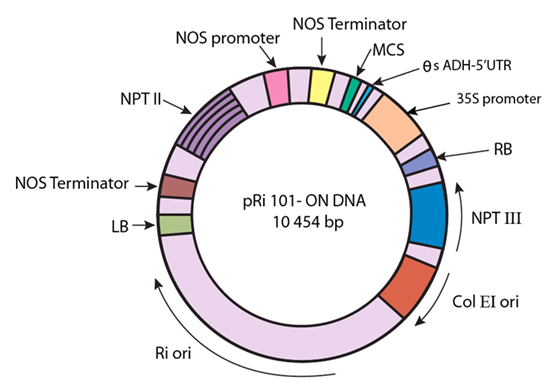
Figure 32.2: Structure of Ri-plasmid
4. The genes responsible for hairy root formation
The agropine-type Ri-plasmid consists of two separate T-DNA regions known as the TL-DNA and TR-DNA. Each of the T-DNA fragments is separated from each other by at least 15 kb of non-integrated plasmid DNA. These two fragments can be transferred separately during the infection procedure. The TR-DNA of the agropine type Ri-plasmid carries genes encoding auxin synthesis ( tms 1 and tms 2) and agropine synthesis (ags). The mannopine type Ri-plasmids contain only one T-DNA. TL-DNA region consists of four root locus (rol ) genetic loci, rol A, rol B, rol C, and rol D, which affect hairy root induction. In particular, rol B seems to be the most important in the differentiation process of transformed cells and also function as induction of hairy roots by hydrolyzing bound auxins leading to an increase in the intracellular levels of indole-3-acetic acid. Gene rol A involved in development of hairy root morphology, rol B is responsible for protruding stigmas and reduced length of stamens; rol C causes internode shortening and reduced apical dominance.
5. Factors influencing the transformation
Following factors influence the transformation process:
- Virulence of A. rhizogenes strains
- Medium
- Age of the explant
- Nature of the explant
6. Confirmation of transformation
Confirmation of transformation can be performed on the basis of following markers:
• Biochemical markers
• Opines
• Mannopines
• Genetic markers
• Southern hybridization
• Polymerase chain reaction
The details are provided in Lecture 27 and 28.
7. Screening of transformation
Screening of transformation can be performed by GUS assay, leaf callus assay, rooting and bleaching assays. The details on screening and selection strategies are explained in Lecture 27.
8. Properties of hairy roots
8.1. Hairy roots
Hairy roots have following properties
• high degree of lateral branching
• profusion of root hairs
• absence of geotropism
• they have high growth rates in culture, due to their extensive branching, resulting in the presence of many meristems.
• they do not require conditioning of the medium .