1. Introduction
Plant remains major source of pharmaceuticals and fine chemicals and cell cultures have been viewed as promising alternatives to whole plant extraction for obtaining valuable chemicals. The major constraint with the cell culture is that they are genetically unstable and tend to produce low yield of secondary metabolites. A new method for enhancing secondary metabolite production is by transformation of cells or tissues using the natural vector system. Agrobacterium rhizogenes, the causative agent of hairy root disease, is a soil dwelling gram negative bacterium capable of entering a plant through a wound and causing a proliferation of secondary roots. The mechanism of transformation is elaborated in Figure 32.1. The biosynthetic capacity of the hairy root cultures is equivalent or sometimes more to the corresponding plant roots. Therefore, hairy root cultures have been developed as an alternate source for the production of root biomass and to obtain root derived compounds.
2. Establishment of hairy root cultures
For the production of hairy root cultures, the explant material is inoculated with a suspension of A. rhizogenes . The bacterial suspension is generated by growing bacteria in Yeast Mannitol Broth (YMB) medium for 2 days at 25°C under shaking conditions. Thereafter, pelleting by centrifugation (5 x 10 rpm; 20 min) and resuspending the bacteria in YMB medium to form a thick suspension (approx. 1010 viable bacteria/ml). Transformation may be inducesd in aseptic seedlings or surface sterilized detached leaves, leaf-discs, petioles, stem segments, from greenhouse grown plants by scratching the leaf midrib or the stem of a plantlet with the needle of a hypodermic syringe containing a small (about 5-10 ul) droplet of thick bacterial suspension of A. rhizogenes.
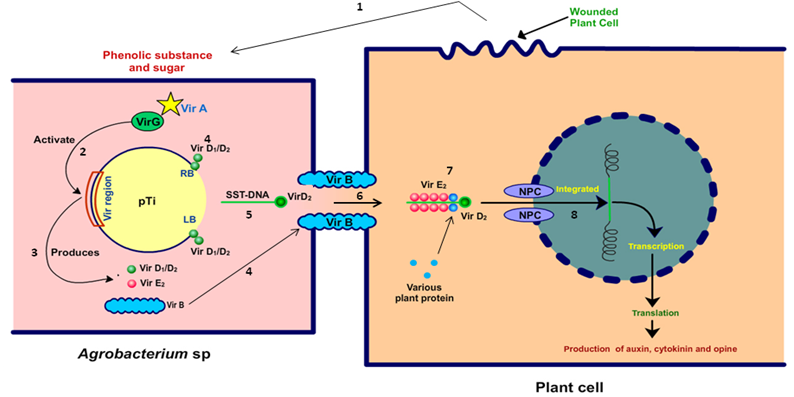
Figure 32.1: The Agrobacterium injects a plasmid (naked circular DNA) into the host cells
Wounded plant cell releases phenolic substances and sugar (1); which are sensed by Vir A, Vir A activates Vir G, Vir G induced for expression of Vir gene of Ri-plasmid (2); Vir gene produces all the Vir -protein (3); Vir D1 and Vir D2 are involved in ssT-DNA production from Ri-plasmid and its export (4) and (5); the ssT-DNA (associated with Vir D1 and Vir D2 ) with Vir E2 are exported through transfer apparatus Vir B (6); in plant cell, T-DNA coated with Vir E2 (7); various plant proteins influence the transfer of T-DNA + Vir D1 + Vir D2 + Vir E2 complex and integration of T-DNA to plant nuclear DNA(8). (LB= left border; RB= Right border; pRi = Ri plasmid, NPC = nuclear pore complex)
3. Genetics of transformation
Ri plasmids contain one or two regions of T-DNA and a Vir (Virulence) region, all of which are necessary for tumorigenesis (Figure 32.2). The Ri plasmid is very similar to Ti plasmid except that their T-DNAs have homology only for auxin and opine synthesis sequences. The T-DNA of Ri plasmid lacks genes for cytokinin synthesis. The T-regions of Ti and Ri plasmids contain oncogenes that are expressed in the plants. Another type, present in Ri plasmids only, appears to impose a high hormone sensitivity on the infected tissue. The T-DNA of Ri plasmids codes for at least three genes that each can induce root formation, and that together cause hairy root formation from plant tissue. Current results indicate that the products of these genes induce a potential for increased auxin sensitivity that is expressed when the transformed cells are subjected to a certain level of auxin. After this stage the transformed roots can be grown in culture without exogenous supply of hormones.
The Ri-plasmids are classified into two main classes according to the opines formed in transformed roots. First, agropine-type strains induce roots to synthesise agropine, mannopine and the related acids. Second, mannopine-type strains which induce roots to produce mannopine and the related acids. The agropine-type Ri-plasmids are very similar as a group and a quite distinct group from the mannopine-type plasmids. Perhaps the most studied Ri-plasmids are agropine-type strains, which are considered to be the most virulent and, therefore, more often used in the establishment of hairy root cultures.