Different systems are now available for gene transfer and successive regeneration of transgenic plants and the most common being Agrobacterium -mediated transformation. However, the preferred host of Agrobacterium is the dicot plants and its efficiency to transfer genes in monocots is still unsatisfactory. The alternative to this, is the introduction of DNA into plants cells without the involvement of a biological agent like, Agrobacterium , and leading to stable transformation is known as direct gene transfer. T he most often applied direct methods are microprojectile bombardment or protoplast transformation.
The direct DNA transfer methods have been subdivided into three categories:
- 1. Physical gene transfer method
2. Chemical gene transfer method
3. DNA imbibitions by cell, tissue and organ
1. Physical gene transfer method
1.1. Particle Bombardment
The Particle bombardment device, well known as the gene gun, was developed to enable penetration of the cell wall so that genetic material containing a gene of interest can be transferred into the cell. This physical direct gene transfer method, gene gun (Figure 24.1) is used for genetic transformation of several organisms to introduce a diverse range of desirable traits. Plant transformation using particle bombardment follows the same steps as in Agrobacterium mediated transformation method:
i. Isolation of desired genes from the source organism
ii. To develop a functional transgenic construct including the selected gene of interest; promoters to drive expression; modification of codon, if needed, to increase successful protein production; and marker genes to facilitate tracking of the introduced genes in the host plant
iii. Insertion of transgenic construct into a useful plasmid
iv. Introduce the transgenes into plant cells
v. Regenerate the plants cells, and
vi. Test the performance of traits or gene expression under in vitro, greenhouse and field conditions.
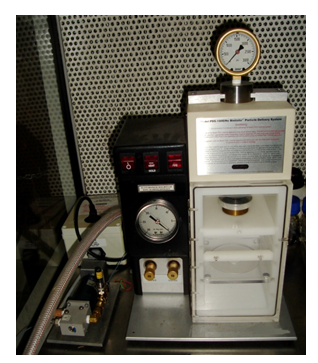
Figure 24.1: A gene gun apparatus
In particle bombardment method, 1-2 µm tungsten or gold particles (called micro-projectiles) coated with genetically engineered DNA are accelerated with air pressure at high velocities and shot into plant tissues on a Petri-plate, as shown in Figure 24.2. This is the second most widely used method, after Agrobacterium mediated transformation, for plant genetic transformation. The device accelerates particles in one of the two ways: (1) by means of pressurized helium gas or (2) by the electrostatic energy released by a droplet of water exposed to high voltage. The earlier devices used blank cartridges in a modified firing mechanism to provide the energy for particle acceleration, and thus, the name particle gun. It is also called Biolistics, Ballistics or Bioblaster).
The microcarriers (or microprojectiles), the tungsten or gold particles coated with DNA, are carried by macrocarriers (macro projectiles) which are then inserted into the apparatus and pushed downward at high velocities. The Macro-projectile is stopped by a perforated plate, while allowing the microprojectiles to propelled at a high speed into the plant cells on the other side. As the micro-projectiles enter the plant cells, the transgenes are free from the particle surface and may inserted into the chromosomal DNA of the plant cells. Selectable markers help in identifying those cells that take up the transgene or are transformed. The transformed plant cells are then regenerated and developed into whole plants by using tissue culture technique.