Structure:
The basic structural features of T4 bacteriophages are illustrated in Figure 2. It is approximately 200 nm long and 80-100 nm wide. Size of other phages is of 20 – 200nm in length. All bacteriophages contain head and tail part. Head part is also termed ad capsid which composed of one or different types of proteins. Genetic materials are present inside and protected by capsid. Tails are attached to the capsid in most of the phages. These are hollow tube like structure through which viruses inject their genetic material inside the host during infection. Tail part is more complex structure in phages. In T4 phage, tail part is surrounded by a contractile sheath and basal plate like structure present at the end of tail from which certain tail fibres are attached. Tail fibres help in attachment phages to bacteria and contractile sheath helps in contraction during infection. Some of the phagesdo not contain tail fibres at the end. Certain other structures are involved in these phages for binding to the bacterium during infection.
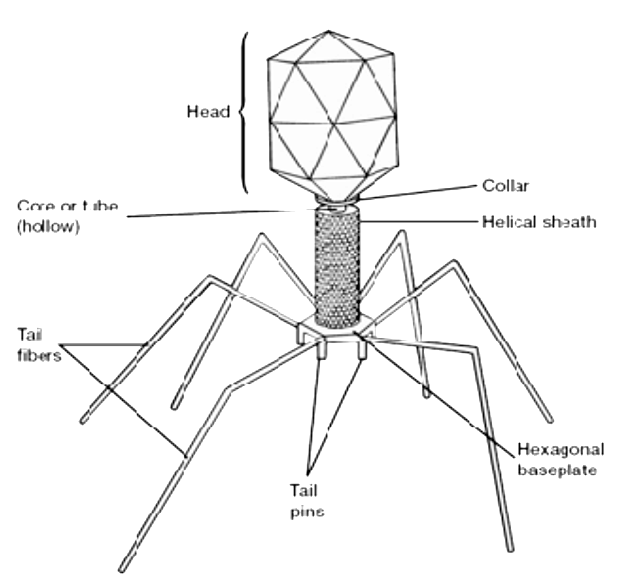
Fig. 9. Structure of T4 Bacteriophage
Infection of Host Cells:
The first step in the infections is binding of phage to bacterium which is mediated by tail fibres are some other structures on those phages that lack tail fibres. Binding of phage tail fibre to bacterium is through adsorption process and it is reversible. There are specific receptors are present on bacterial cell surface through which phages bind on it by its tail fibre. These receptors are proteins, lipopolysaccharides, pili and lipoproteins of bacterium. Some phages lacking basal plate and tail fibre bind tightly to bacterial cell surface and it is reversible.
After binding of phage to bacterium, there is contraction in tail by contractile sheath and phages inject their genetic material through hollow tube like tail. Some phages also contain certain enzymes that digest the bacterial cell surface. Phages that don't contain tail fibre and contractile sheath, uses different mechanism for inject its own genetic material inside the host. Only genetic material of phages enters inside the bacterium and the remainder of phages (ex. capsid) remain outside of bacterium.