Nomenclature (Binomial system)
Biologists in the middle ages used to follow polynomial system, i.e naming organisms with many names (poly -many, nomo - name). For example name for the European honeybee, was Apis pubescens, thorace subgriseo, abdomine fusco, pedibus posticis glabris utrinque margine ciliatis (just for example no need to be memorized). Later Binomial systems were developed by Swedish biologist Carolus Linnaeus (1707–1778) based on the anatomical characteristics of plants and animals. Nomenclature in microbiology is developed based on the principals established for the plant and Animal kingdom by Linnaeus. The first word in the binomial is the genus name and is always capitalized. The second word is species name and never capitalized. For example honeybee, Apis mellifera
Taxonomic ranks:
In prokaryotic taxonomy the most commonly used levels or ranks (in ascending order) are species, genera, families, orders, classes, phyla, kingdom or domain. In order to remember the seven categories of the taxonomic hierarchy in their proper order, it may be useful to memorize a phrase such as “ k indly p ay c ash o r f urnish g ood s ecurity” (k ingdom– p hylum– c lass– o rder– f amily– g enus– s pecies). The basic taxonomic group in microbial taxonomy is the species.
A species is a collection of strains that have a similar G+C composition and 70% or greater similarity as judged by DNA hybridization. Ideally a species also should be phenotypically distinguishable from other similar species. An example of hierarchy in taxonomy is given below.
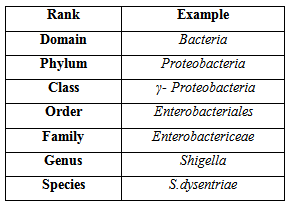
A strain is a population of organisms that is distinguishable from at least some other populations within a particular taxonomic category. It is considered to have descended from a single organism or pure culture isolate. Strains within a species may differ slightly from one another in many ways. Biovars are variant prokaryotic strains characterized by biochemical or physiological differences, morphovars differ morphologically, and serovars have distinctive antigenic properties . One strain of a species is designated as the type strain. It is usually one of the first strains studied and often is more fully characterized than other strains; however, it does not have to be the most representative member but this strain can be considered as reference strain and can be compared with other strains. Each species is assigned to a genus, the next rank in the taxonomic hierarchy. A genus is a well-defined group of one or more species that is clearly separate from other genera.
Techniques for identifying or determining taxonomical characters
In order to identify and classify microorganisms, we need to know about their characteristics. There are two ways to determine the taxonomical characters; classical and molecular characters
Classical characteristics:- This approach uses morphological, biochemical, physiological, ecological and genetic characteristics. It is mainly used in microbial taxonomy.
- 1. Morphology:- Morphology is the one which can be easily studied and analyzed. Structural features (cell shape, size, colony morphology, appendages, and etc.) depend on the expression of many genes, are usually genetically stable.
2. Physiology and metabolism:- Organisms are classified based on the requirements for growth characters like carbon and nitrogen sources, cell wall constituents, general nutritional type, energy sources, optimum growth temperature, Motility.
3. Ecology:- These are taxonomically valuable because even very closely related microorganisms can differ considerably with respect to ecological characteristics. The ability to cause disease in a particular host; and habitat preferences such as requirements for temperature, pH, oxygen, and osmotic concentration are examples of ecological characteristics.
4. Genetic analysis:- The study of chromosomal gene exchange between species through transformation and conjugation (in Enteric bacteria) is sometimes useful in their classification. Most bacteria are harboring plasmids, classification based on plasmid is also an important part of classification.