RNA processing (for eukaryotes)
Eukaryotic genes contain Exons (which encode information that will end up being translated into protein) separated by Introns (sequences that will not encode proteins). At the 5' end of a gene we find a promoter and often a CpG island. Both of these elements regulate the transcription of a gene. At the 3' end of a gene we find a stop sequence, and a signal for polyadenylation (AAUAAA). In Eukaryotes this primary RNA transcript is then processed into a messenger RNA (mRNA) if the gene is to be translated into protein. This involves removing introns, which do not encode for protein, and splicing the remaining exons together. At the 5´ end of the mRNA a 7-Methyguanosine residue is added to provide a protective cap. At the 3´ end of the mRNA, 50-100 adenosine residues are added, generating a poly A tail.
REVERSE TRANSCRIPTION
Some viruses (such as HIV, the cause of AIDS), have the ability to transcribe RNA into DNA. HIV has an RNA genome that is duplicated into DNA. The resulting DNA can be merged with the DNA genome of the host cell. The main enzyme responsible for synthesis of DNA from an RNA template is called reverse transcriptase. In the case of HIV, reverse transcriptase is responsible for synthesizing a complementary DNA strand (cDNA) to the viral RNA genome. An associated enzyme, ribonuclease H, digests the RNA strand, and reverse transcriptase synthesizes a complementary strand of DNA to form a double helix DNA structure. This cDNA is integrated into the host cell's genome via another enzyme (integrase) causing the host cell to generate viral proteins that reassemble into new viral particles. In HIV, subsequent to this, the host cell undergoes programmed cell death, apoptosis of T cells. However, in other retroviruses, the host cell remains intact as the virus buds out of the cell.
Some eukaryotic cells contain an enzyme with reverse transcription activity called telomerase. Telomerase is a reverse transcriptase that lengthens the ends of linear chromosomes. Telomerase carries an RNA template from which it synthesizes DNA repeating sequence, or "junk" DNA. This repeated sequence of DNA is important because, every time a linear chromosome is duplicated, it is shortened in length. With "junk" DNA at the ends of chromosomes, the shortening eliminates some of the non-essential, repeated sequence rather than the protein-encoding DNA sequence farther away from the chromosome end. Telomerase is often activated in cancer cells to enable cancer cells to duplicate their genomes indefinitely without losing important protein-coding DNA sequence. Activation of telomerase could be part of the process that allows cancer cells to become immortal .
Translation: the Synthesis of Proteins
Role of mRNA
- carries codons (3-nucleotide sequences) arranged in linear fashion that code for amino acids
- also carries signals needed to tell how to recognize ribosomes, start and stop signals for decoding protein
- leader sequence on small ribosome subunit binds to complementary sequence on mRNA, allows initial formation of RNA-ribosome complex.
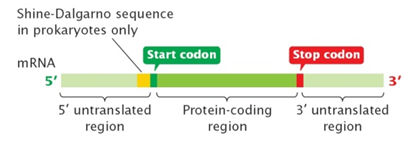
Fig. 14. Role of mRNA
Role of ribosome
- two parts: a small subunit and a large subunit . These are separated except when attached to m-RNA
- ribosomes contain a set of ribosomal proteins and several types of ribosomal RNA (r-RNA)
- ribosomes catalyze the formation of peptide bonds; intially thought to be due to protein activity (enzyme), but now known to be due to RNA catalytic activity (ribozyme).
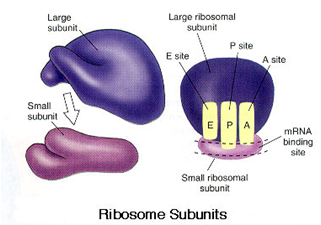
Fig. 15. Ribosome
Role of tRNA
- structure: 4 loops, anticodon, AA binding site
- ~ 60 types in bacteria (>100 in mammals)
- only 73-93 nucleotides long
- some bases modified after transcription; like pseudouridine.
- extensive hairpin loops
- anticodon site: recognizes codon on mRNA
- Activation of tRNA: adding amino acids
- requires special enzyme: AA-tRNA activating enzymes
- ATP required, forms AA-AMP + PP, then AA-tRNA + AMP
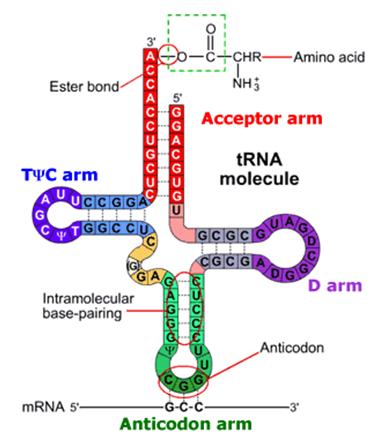
Fig. 16. tRNA strcuture
Initiation of Translation
- small ribosomal subunit initiates binding to mRNA
- locates 5' end of mRNA
- small subunit ribosome finds first AUG codon = start codon
- large ribosome binds
- tRNA carries the amino acid methionine to first position
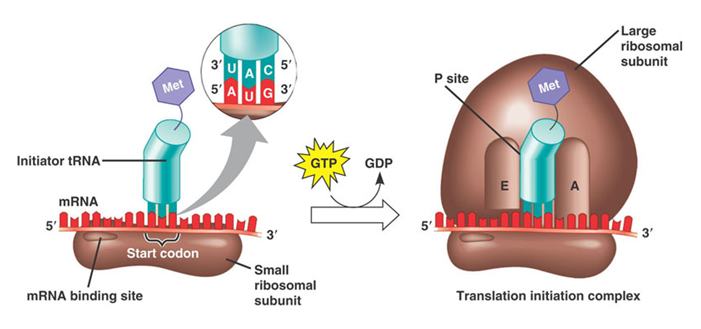
Fig. 17. Initiation of translation