The β- oxidation pathway
Characteristic features;
• Every other carbon is converted to a C=O
• Allows nucleophilic attack by CoA-SH on remaining chain
• 1 CoA is used for every 2 carbon segment to release acetyl-CoA
• Each round produces
1 FADH2 , 1 NADH, 1 Acetyl-CoA (2 in the last round)
Step 1: Dehydrogenation of Alkane to Alkene Catalyzed by isoforms of acyl-CoA dehydrogenase (AD) on the inner mitochondrial membrane
Step 2: Hydration of Alkene Catalyzed by two isoforms of enoyl-CoA hydratase:
Soluble short-chain hydratase (crotonase) Membrane-bound long-chain hydratase, part of trifunctional complex Water adds across the double bond yielding alcohol
Step 3: Dehydrogenation of Alcohol Catalyzed by β-hydroxyacyl-CoA dehydrogenase The enzyme uses NAD cofactor as the hydride acceptor Only L-isomers of hydroxyacyl CoA act as substrates Analogous to malate dehydrogenase reaction in the CAC.
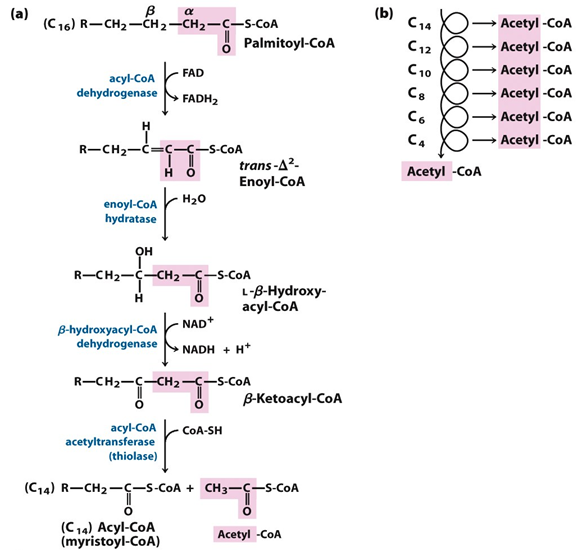
Fig. 14 . The β- oxidation pathway
Step 4: Transfer of Fatty Acid Chain Catalyzed by acyl-CoA acetyltransferase (thiolase) via covalent mechanism, The carbonyl carbon in b -ketoacyl-CoA is electrophilic Active site thiolate acts as nucleophile and releases acetyl-CoA; Terminal sulfur in CoA-SH acts as nucleophile.
The fatty acid is now two carbons shorter and an Acetyl-CoA, has been generated which can be fed into the TCA cycle. The smaller fatty acid moves through the β-oxidation pathway again, producing another Acetyl-CoA and shrinking by 2 carbons.
By performing successive rounds of beta oxidation on a fatty acid, it is possible to convert it completely to Acetyl-CoA. Often fatty acids with odd numbers of carbons, the final reaction will yield acetyl-CoA and Coenzyme-A hooked to a three carbon fatty acid (propionyl-CoA). Propionyl-CoA is handled differently by different bacteria. In E. coli it is converted into pyruvate.
REFERENCES:
Text Books:
1. Jeffery C. Pommerville. Alcamo's Fundamentals of Microbiology (Tenth Edition). Jones and Bartlett Student edition.
2. Gerard J. Tortora, Berdell R. Funke, Christine L. Case. Pearson - Microbiology: An Introduction. Benjamin Cummings.
Reference Books:
1. Lansing M. Prescott, John P. Harley and Donald A. Klein. Microbiology. Mc Graw Hill companies.