B. Lipid Catabolism
Microorganisms frequently use lipids as energy sources. Triglycerides or triacylglycerols, esters of glycerol and fatty acids, are common energy sources. They can be hydrolyzed to glycerol and fatty acids by microbial lipases. The glycerol is then phosphorylated, oxidized to dihyroxyacetone phosphate, and catabolised in the glycolytic pathway.
1. Lipases are enzymes that break down fats into fatty acid and glycerol components
2. Beta oxidation is the breakdown of fatty acids into two carbon segments (acetyl CoA),
Which can enter the Krebs cycle.
Functions of lipids in Microbes
• Lipids are essential to the structure and function of membranes
• Lipids also function as energy reserves, which can be mobilized as sources of carbon
• 90% of this lipid is “triacyglycerol”
Triacyglycerol -----lipase-----> glycerol + 3 fatty acids
• The major fatty acid metabolism is “β-oxidation”
Lipids are broken down into their constituents of glycerol and fatty acids
Glycerol is oxidised by glycolysis and the TCA cycle.
• Bacteria are capable of growth on fatty acids and lipids. Lipids are part of the membranes of living organisms and if available (usually because the organism that was using them dies) can be used as a food source.
• Lipids are large molecules and cannot be transported across the membrane.
• A class of extracellular enzymes called lipases are responsible for the breakdown of lipids. Lipases attack the bond between the glycerol molecule oxygen and the fatty acid.
• Phospholipids are attacked by phospholipases. There are four classes of phospholipases given different names depending upon the bond they cleave. Phospholipases are not particular about their substrate and will attack a glycerol ester linkage containing any length fatty acid attached to it. The result of this digestion is a hydrophillic head molecule, glycerol and fatty acids of various chain lengths.
• The head can be one of several small organic molecules that are funneled into the TCA cycle by one or two reactions that we won't cover here.
• Glycerol is converted into 3-Phosphoglycerate (depending upon the action of phospholipase C or phospholipase D) and eventually pyruvate via glycolysis.
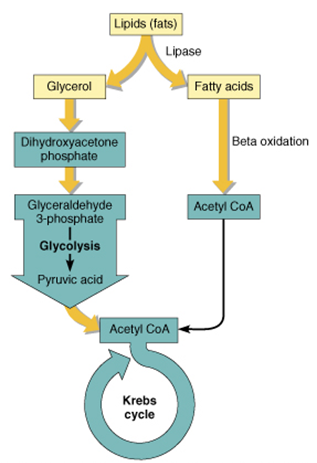
Fig. 13 . Lipid Catabolism