Antifungal drugs:
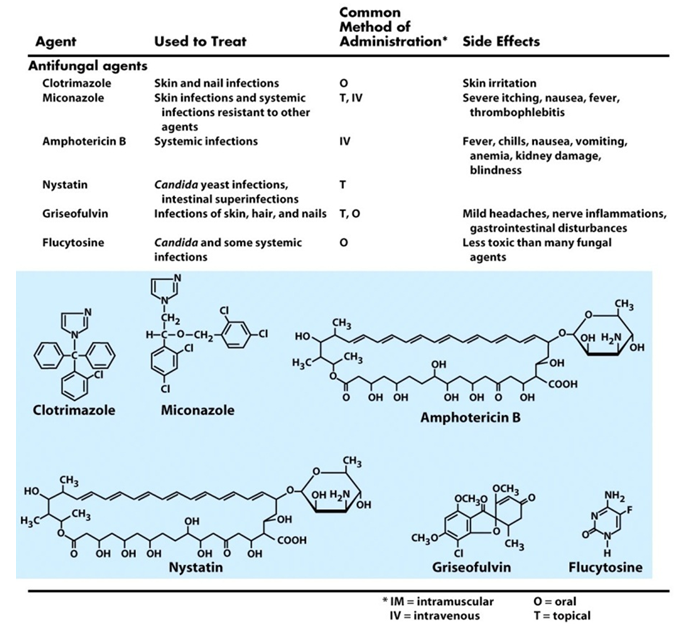
Table 3. Antifungal drugs
 '
'
Fungal cells are similar to human cells than the bacterial cells and hence treatment of fungal infections generally has been less successful than that of bacterial infections. Many drugs are quite toxic for humans and they have a detoxification system that modifies many antibiotics, probably by hydroxylation. Despite their low therapeutic index, a few drugs are useful in treating major fungal diseases. Fungal infections are often subdivided into infections of two types, superficial mycoses and systemic mycoses. Several drugs are used to treat superficial mycoses like dermatophyte infections such as athlete's foot (Clotrimazole, micomazole, ketoconazole), and oral and vaginal candidiasis (Nystatin). They are thought to disrupt fungal membrane permeability and inhibit sterol synthesis. Griseofulvin is given orally to treat chronic dermatophyte infections. It is thought to disrupt the mitotic spindle and inhibit cell division; it also may inhibit protein and nucleic acid synthesis.
Systemic infections are very difficult to control and can be fatal. Amphotericin B is commonly used and it binds to the sterols in fungal membranes, disrupting membrane permeability and causing leakage of cell constituents. It is used only for life threatening infections. Fluconazole is used in the treatment of candidiasis, cryptococcal meningitis and coccidioidal menginitis. Just like antibacterial drugs, overuse of antifungal drugs leads to an increase in drug resistance. For example, Candida infections are becoming more frequent and drug resistant.
Antiviral drugs:
Table 4. Antiviral Drugs
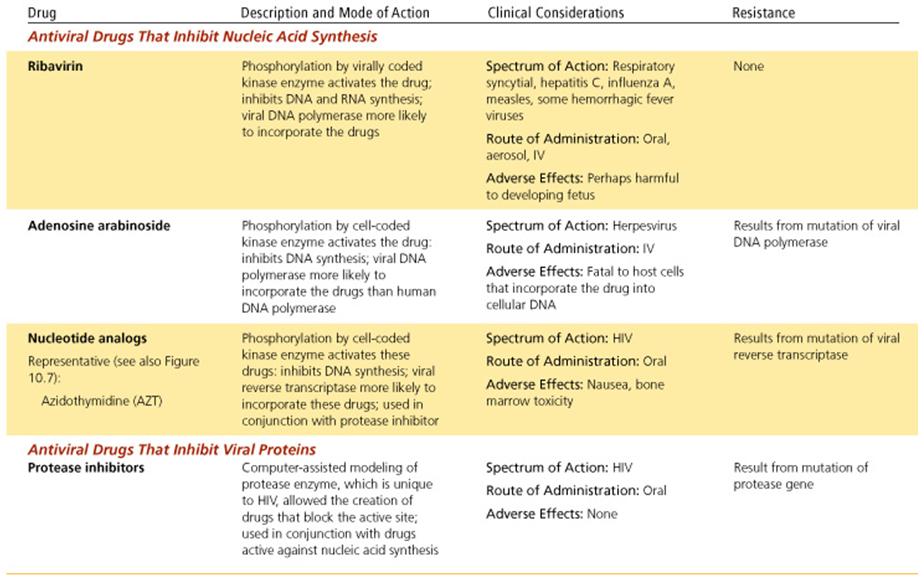
Most antiviral drugs disrupt either critical stages in the virus life cycle or the synthesis of virus-specific nucleic acids. Amantadine and rimantadine can be used to prevent influenza a infections. Amantadine blocks the penetration and uncoating of influenza virus particles. Acyclovir, is also used in the treatment of herpes infections. Research on anti-HIV drugs has been particularly active. Many of the first drugs to be developed were reverse transcriptase inhibitors such as azidothymidine (AZT). These interfere with reverse transcriptase activity and therefore block HIV reproduction. More recently HIV protease inhibitors have been developed. These mimic the peptide bond that is normally attacked by the protease. Probably the most publicized antiviral agents are interferons. These small proteins, produced by the host, inhibit virus replication and may be clinically useful in the treatment of influenza, hepatitis, herpes and colds.
REFERENCES:
Text Books:
1. Jeffery C. Pommerville. Alcamo's Fundamentals of Microbiology (Tenth Edition). Jones and Bartlett Student edition.
2. Gerard J. Tortora, Berdell R. Funke, Christine L. Case. Pearson - Microbiology: An Introduction. Benjamin Cummings.
Reference Books:
1. Lansing M. Prescott, John P. Harley and Donald A. Klein. Microbiology. Mc Graw Hill companies.