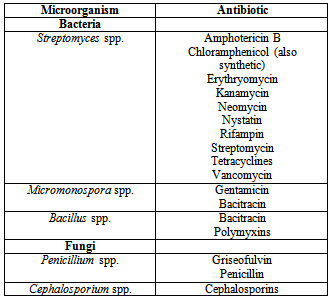
Drugs can range in their effectiveness. Many are narrow-spectrum drugs- that are; they are effective only against a limited variety of pathogens, while the broad-spectrum drugs attack many different kinds of pathogens. Drugs can be classified according to the microbial group they act against; antibacterial, antifungal, antiprotozoan and antiviral. Chemotherapeutic agents can be synthesized by microorganisms or manufactured by chemical procedures independent of microbial activity. Most of the agents are natural or synthesized by bacteria or fungi (Table 1). In contrast, several important agents are completely synthetic (Sulphonamides, trimethoprim, chloramphenicol, ciprofloxacin, isoniazid and dapsone). While some are semi synthetic, natural antibiotics that have been chemically modified by the addition of extra groups to make them less susceptible to inactivation by pathogens. Ampicillin, carbenicillin, and methicillin are good examples.
Table 1. Microbial sources of some antibiotics
Mechanism of action:
An antimicrobial agent's adverse effect on cells is known as its mode of action. They have a range of cellular targets (Table 2). They fall in the following categories:
- 1. Cell wall synthesis inhibition
2. Protein synthesis inhibition
3. Nucleic acid synthesis inhibition
4. Cell membrane disruption
5. Metabolic antagonism
The most selective antibiotics are those that interfere with the synthesis of bacterial cell walls (e.g., penicillin, cephalosporins, vancomycin and bacitracin). These drugs have a high therapeutic index because bacterial cell walls have a unique structure not found in eukaryotic cells. The next selective antibiotics are those that inhibit protein synthesis by binding to the prokaryotic ribosome. These drugs can discriminate between the prokaryotic and eukaryotic ribosomes and hence their therapeutic index is high too. Some drugs bind to the 30S while others bind to the 50S ribosomal subunit. Several different mechanisms can be affected: aminoacyl t-RNA binding, peptide bond formation, mRNA reading and translocation (e.g., streptomycin, gentamicin, spectinomycin, clindamycin, chloramphenicol, tetracycline, erythromycin etc). The drugs that inhibit nucleic acid synthesis or damage cell membranes are often not as selectively toxic as other antibiotics, the reason being that prokaryotes and eukaryotes do not differ much with respect to nucleic acid synthetic mechanisms or the cell membrane structure (e.g., quinolones and polymyxins). The last category of drugs act as antimetabolites: they block the functioning of metabolic pathways by competitively inhibiting the use of metabolites by key enzymes. Sulfonamides and several other drugs inhibit folic acid metabolism (e.g., sulphanilamide, sulfamethoxazole and sulfacetamide). Most bacterial pathogens synthesize their own folic acid and are therefore susceptible to inhibitors of folate metabolism. Humans cannot synthesize folic acid and must obtain it from in their diet and hence does not affect the host and has high therapeutic index.