Aerotolerant microorganisms may lack catalase but almost always have superoxide dismutase. Strict anaerobes lack either of the enzymes or have them in very low concentrations and therefore cannot tolerate O2. Aerobic microorganisms can be grown in an aerated medium which is aerated by shaking the vessel or sterile air is pumped. But for anaerobes, O2 must be excluded from the medium. Reducing agents such as thioglycollate or cysteine can be used to flush out O2. Nitrogen gas can also be used to eliminate O2 with a vacuum pump, and sometimes CO2 and nitrogen is added to the chamber, as anaerobes require a small amount of CO2 for best growth and also gas pack jar can also be used.
Pressure: Most microorganisms always are subjected to pressure of 10 atmospheres (atm). The hydrostatic pressure can reach to 600 to 1100 atm in the deep sea with temperature about 2°C to 3°C. Organisms can survive and adapt at these extreme conditions and many are barotolerant, increased pressure does adversely affect them but not as much as it does to nontolerant bacteria. The barophillic organisms are those growing in the guts of deep sea invertebrates such as amphipods and holothurians and grow more rapidly at high pressures. These bacteria may play an important role in nutrient recycling in the deep sea. Bacterial genera of Photobacteria, Shewanella, Colwellia are barophiles. Some members of the Archaea are thermophiles for example Pyrococcus spp., Methanococcus janaschii .
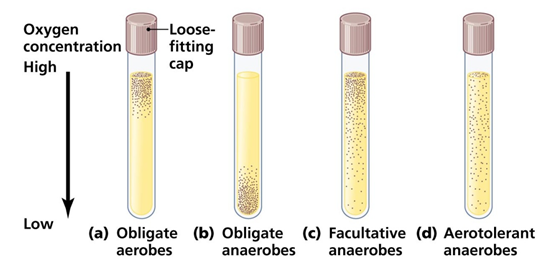
Fig. 6. Oxygen requirements in bacteria
Pressure:
Most organisms on land or on the surface of water is always subjected to a pressure of 1 atm. The hydrostatic pressure can reach 600 to 1100 atm in the deep sea. Despite these extremes, bacteria survive and adapt. Many are barotolerant. Some bacteria in the gut of deep sea invertebrates such as amphipods and holothurians are truly barophilic and grow more rapidly at high pressures (Ex. Photobacterium, shewanella, Colwellia ).