In this lecture we shall be dealing with the uptake of nutrients by microorganisms and the different ways by which movement of materials takes place across the plasma membrane.
Uptake of the required nutrients by the microbial cell is important. Since microorganisms live in nutrient poor habitats, they must be able to transport nutrients from dilute solutions into the cell against concentration gradient. Finally, they must pass through a selectively permeable plasma membrane. Microorganisms use different transport mechanisms like facilitated diffusion, active transport and group translocation. Eukaryotic microorganisms do not employ group translocation but take up nutrients by endocytosis.
Movement of materials across the plasmamembrane is mostly done by two processes:
Passive processes : Substances cross the area from an area of high concentration to an area of low concentration without any expenditure of energy (ATP). Example, simple diffusion, osmosis and facilitated diffusion.
Active process: The cell must use energy (ATP) to move substances from areas of low concentration to areas of high concentration. Example, Group translocation.
Passive processes:
Passive or simple diffusion :Often called diffusion, is the process in which molecules move from a region of higher concentration to one of lower concentration. The rate is dependent on the size of the concentration gradient between a cell's exterior and its interior. Very small molecules such as water and oxygen and carbon dioxide move across membranes by simple or passive diffusion. Larger molecules, ions, and polar substances do not cross membranes by this method.
Osmosis: Is the net movement of solvent molecules across a selectively permeable membrane from an area in which the solvent molecules are highly concentrated to an area of low concentration until equilibrium is reached. In living systems the chief solvent is water. The three types of solutions which are normally found are isotonic, hypotonic and hypertonic.
Facilitated diffusion: The rate of diffusion across selectively permeable membrane is greatly increased by using carrier proteins, sometimes called permeases which are embedded in the plasma membrane. Because a carrier aids the diffusion process, it is called as facilitated diffusion. Carrier proteins also resemble enzymes in their specificity for the substances to be transported; each carrier is selective and will transport only closely related solutes. Because there is no energy input, molecules will continue to enter only as long as their concentration is greater on the outside. Two widespread major intrinsic protein channels in bacteria are aquaporins that transport water and glycerol facilitators which aid glycerol diffusion. The carrier protein complex spans the membrane (Figure 1). After the solute molecule binds to the outside, the carrier may change conformation and release the molecule on the cell interior. The carrier would subsequently change back to its original shape and be ready to pick up another molecule. The mechanism is driven by concentration gradients and therefore is reversible.
Examples. Glycerol is transported by facilitated diffusion in E.coli, Salmonella typhimurium, Pseudomonas, Bacillus and many other bacteria. This is prominent in eukaryotes where it is used to transport a variety of sugars and amino acids.
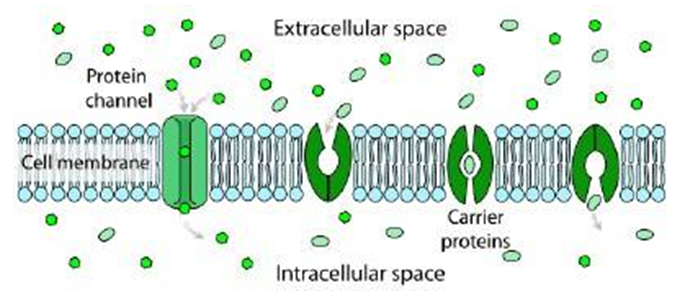
Fig. 1. Facilitated diffusion. The carrier proteins aid in the release of solute molecules from extracellular space to the intracellular space.