6-5.3(a).1 Molecular Marker’s for Gene Mapping
There are many molecular markers which can be used as detection systems for genetic variations by using genomic DNA for genetic analysis. Among these techniques, Restriction fragment length polymorphisms (RFLP), Random amplification of polymorphic DNA (RAPD), amplified fragment length polymorphism (AFLP), Simple Sequence Repeat (SSR), and Single Nucleotide Polymorphisms (SNP) are most commonly used in genetic linkage analysis.
6-5.3(a).1.1 Restriction fragment length polymorphisms (RFLP)
►RFLPs based molecular markers are amongst the first generation molecular markers used for many animal and plant genome mapping projects.
►This technique is based on digesting genomic DNA with a certain restriction enzymes and followed by southern blotting.
Due to mutation there is a chance of gain or loss of restriction sites.
►As a result when homologous chromosomes are digested with restriction enzymes, electrophoresis and probed fragment length polymorphism is obtained (Figure 6-5.3(a).1.1) .
►RFLPs are so sensitive that it can detect single- nucleotide mutations, deletions or insertions of DNA fragments of very small number of base pairs (1-100bp).
►Rearrangements of DNA on large chromosomal fragments can also be detected by RFLPs.
RFLPs are well known for its robustness and accuracy in genotyping.
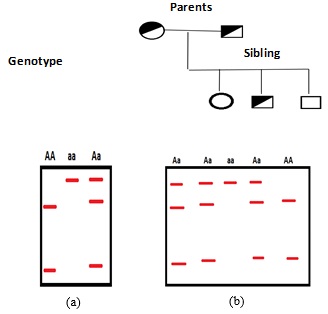
Figure 6-5.3(a).1.1: Restriction fragment length polymorphisms (RFLP): (a) shows the RFLP pattern homozygous and heterozygous parents.(b) The RFLP pattern of offspring which can be compared with parents to develop a RFLP map.