5-3.1.1 (a). Procedure
The host cells and the DNA molecules to be transported into the cells are suspended in a solution. The basic process inside an electroporation apparatus is represented in a schematic diagram (Figure 5-3.1.1(a).).
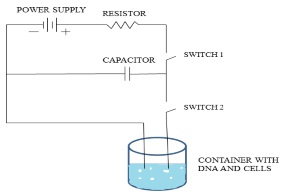
Figure 5-3.1.1(a): The basic circuit setup of the electroporation apparatus.
(Adapted from http://o]pbs.okstate.edu/~melcher/MG/MGW4/MG431.html)
- When the first switch is closed, the capacitor charges up and stores a high voltage which gets discharged on closing the second switch.
- Typically, 10,000-100,000 V/cm in a pulse lasting a few microseconds to a millisecond is essential for electroporation which varies with the cell size.
- This electric pulse disrupts the phospholipid bilayer of the membrane causing the formation of temporary aqueous pores.
- When the electric potential across the cell membrane is increased by about 0.5-1.0 V, the charged molecules e.g. DNA migrate across the membrane through the pores in a similar manner to electrophoresis.
- The initiation of electroporation generally occurs when the transmembrane voltage reaches at 0.5-1.5 V. The cell membrane discharges with the subsequent flow of the charged ions and molecules and the pores of the membrane quickly close reassembling the phospholipid bilayer.