Recombinant AAV (rAAV) is used as an expression cassette containing a reporter or candidate gene of interest. The foreign gene replaces all of the viral genes present in a wild type virus. Only the inverted terminal repeats are left to function as the essential replication/packaging signal.
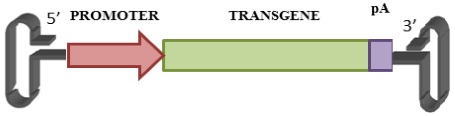
Figure 5-1.4.2(c): Organization of a typical recombinant AAV (rAAV) genome. pA represents Poly A tail.
(Adapted from http://aavvectors.tripod.com/id3.html)
Advantages
- Stable and have a wide host range
- Lack of initiating an immune response
- The dependence of AAV on a heterologous helper virus provides higher control over vector replication, making AAV vectors safer for use in gene therapy
- Potential of targeted/site-specific integration
- Non-pathogenic
Disadvantages
- AAV uses concatemeric replication intermediates
- They must be closely screened as they are often contaminated with adenovirus or Herpes Virus.
- Insert size is limited (4Kb)
- Difficult generation of high virus titres