The steps involved in DNA binding and cleavage by a type II restriction endonuclease:
- These enzymes have nonspecific contact with DNA and initially bind to DNA as dimmers.
- The target site is then located by a combination of linear diffusion or “sliding” of the enzyme along the DNA over short distances, and hopping/jumping over longer distances.
- Once the target restriction site is located, the recognition process (coupling) triggers large conformational changes of the enzyme and the DNA, which leads to activation of the catalytic center.
- Catalysis results in hydrolysis of phosphodiester bond and product release.
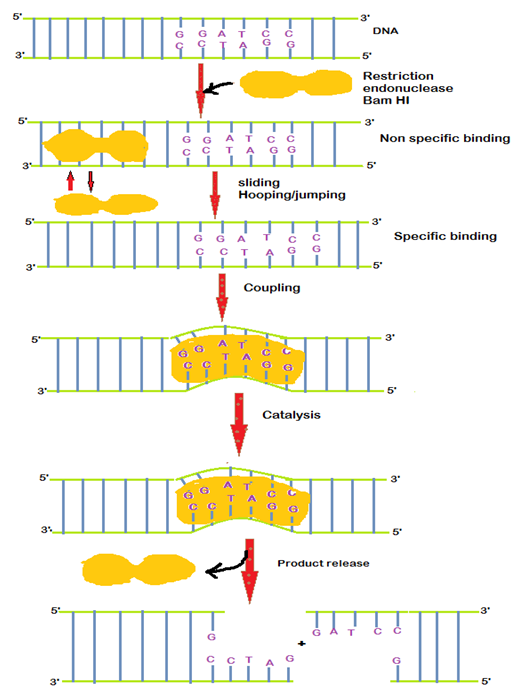
Fig 2-1.4.2: Structures of free, nonspecific, and specific DNA-bound forms of BamHI. The two dimers are shown in brown, the DNA backbone is in green and the bases in gray. BamH I becomes progressively more closed around the DNA as it goes from the nonspecific to specific DNA binding mode.