2-1.1 Introduction:
A restriction enzyme is a nuclease enzyme that cleaves DNA sequence at a random or specific recognition sites known as restriction sites. In bacteria, restriction enzymes form a combined system (restriction+ modification system) with modification enzymes that methylate the bacterial DNA. Methylation of bacterial DNA at the recognition sequence typically protects the own DNA of the bacteria from being cleaved by restriction enzyme.
There are two different kinds of restriction enzymes:
(1) Exonucleases catalyses hydrolysis of terminal nucleotides from the end of DNA or RNA molecule either 5'to 3' direction or 3' to 5' direction. Example: exonuclease I, exonuclease II etc.
(2) Endonucleases can recognize specific base sequence (restriction site) within DNA or RNA molecule and cleave internal phosphodiester bonds within a DNA molecule. Example: EcoRI, Hind III, BamHI etc.
2-1.2History:
In 1970 the first restriction endonuclease enzyme Hind II was isolated. For the subsequent discovery and characterization of numerous restriction endonucleases, in 1978 Daniel Nathans, Werner Arber, and Hamilton O. Smith awarded for Nobel Prize for Physiology or Medicine. Since then, restriction enzymes have been used as an essential tool in recombinant DNA technology.
2-1.3 Restriction Endonuclease Nomenclature:
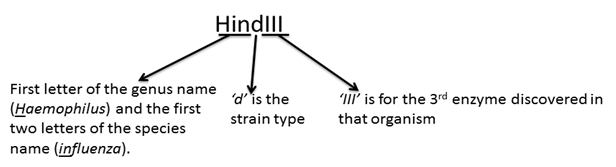
Restriction endonucleases are named according to the organism in which they were discovered, using a system of letters and numbers. For example, HindIII (pronounced “hindee-three” ) was discovered in Haemophilus influenza (strain d). The Roman numerals are used to identify specific enzymes from bacteria that contain multiple restriction enzymes indicating the order in which restriction enzymes were discovered in a particular strain.