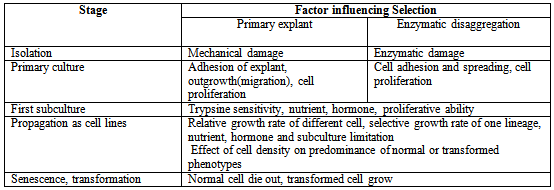
Characteristics of Cell lines: Each cell line is distinguished by characteristic features which render these cells unique and biomedically or biotechnologically useful.
• The growth pattern and morphological appearance of the cell line should be determined and should be stable from the master cell bank to the end-of-production cells.
• If there are specific markers that may be useful in characterizing the cell line (such as marker chromosomes, specific surface markers), these should be characterized for stability.
• Mostly cultured cell lines are allowed to generate their own ECM (extra cellular matrix), but primary culture and propagation of some specialized cells, exogenous provision of ECM.
• Many transformed cell lines have provided the best model for the induction of differentiation.
• Since normal cells has limited dividing capacity, therefore after a fixed number of population doublings cell lines derived from normal tissue will die out. This is a genetically determined event involving several different genes and this phenomenon is known as senescence . If the cells have an identified finite life expectancy, the total number of population doubling levels through senescence should be determined.
• Some cell lines may avoid senescence and give rise to continuous cell lines. The ability of a cell line to grow continuously probably reflects its capacity for genetic variation, allowing subsequent selection.
• A common feature of many human continuous cell lines is the development of a subtetraploid chromosome number. The alteration in a culture that gives rise to a continuous cell line is commonly called in vitro transformation and may occur spontaneously or be chemically or virally induced.
Table 2: Selection in cell line Development