Cell culture is the multifaceted process through which cells are isolated from animal or plant and their subsequent growth under controlled artificial conditions, generally outside their natural environment. In this procedure cells are directly isolated from body or disaggregated by enzymatic or mechanical procedure or they may be derived from cell lines or cell strains. The historical development and methods of cell culture are closely interrelated to those of tissue culture and organ culture. The in vitro propagation of cells has become a common practice in many laboratories for a huge numbers of applications. The range of cell types grown is vast. Generally the cells are sensitive to a wide range of compounds and it is therefore necessary to ensure that they come into contact only with those under study and not with extraneous materials. Adherent mammalian cells require a suitable surface for attachment.
Primary cell culture: Primary cell culture is the primary step of cell culturing in which the cell is first isolated from tissue and then proliferated under the appropriate conditions until they consume all available contents for their growth. Now the cell is ready for subculturing by transferring them to new growth medium that furnish more opportunity for continued growth.
Cell lines: A cell line is a permanently established cell culture that will proliferate indefinitely in appropriate fresh medium and space. Cell lines differ from cell strains in that they have absconded the Hayflick limit and become immortalised. The Hayflick limit (or Hayflick Phenomenon) is the number of times a normal cell population will divide before it stops, presumably because the telomeres reach a critical length. A cell line arises from a primary culture at the time of the first successful subculture. The terms finite or continuous are used as prefixes if the status of the culture is known.
Cell Strain: By applying cloning, the positive population of cell lines are selected, therefore this cell lines now becomes a cell strain. A cell strain often acquires additional genetic changes resulting to the initiation of the parent line.
Continuous cell culture: A continuous cell culture is one that is apparently capable of an unlimited number of population doublings, often referred to as an immortal cell culture. Such cells may or may not express the characteristics of in vitro neoplastic or malignant transformation. Continuous cell lines are usually aneuploid and often have a chromosome number between the diploid and tetraploid values. There is also considerable variation in chromosome number and constitution among cells in the population (heteroploidy).
Some important properties of Continuous cell lines:
• Reduced serum requirement
• Reduced density limitation of growth
• Growth in semisolid media
• Aneuploidy
Several normal cells do not give rise to continuous cell lines. The classical example are normal human fibroblasts that remain euploid throughout their life span and at crisis (usually around 50 generations) will stop dividing, although they may remain viable for up to 18 months thereafter. Human glia and chick fibroblasts behave similarly. Epidermal cells, on the other hand, have shown gradually increasing life spans with improvements in culture techniques.
Finite cell culture: A finite cell culture is capable of only a limited number of population doublings after which the culture ceases proliferation.
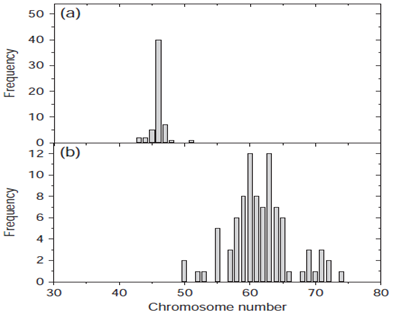
Figure 1: Chromosome Numbers of Finite and Continuous Cell Lines.