Functions of cGMP:
1. cGMP is an important molecule of the cell that takes part in various activities in cellular system. When guanylyl cyclase stimulation leads to elevated levels of cGMP, it then mediates biological responses, such as blood vessel dilation which increases blood flow.
2. The action of cGMP is regularly facilitated by stimulation of cGMP dependent protein kinases, although cGMP is a common regulator of ion channel conductance, glycogenolysis, cellular apoptosis and phosphodiesterases.
3. Another well-known role of cGMP is in the vertebrate eye, where it serves as the second messenger responsible for converting the visual signals received as light to nerve impulses. The photoreceptor in rod cells of the retina is a G protein-coupled receptor called rhodopsin. When light falls on the extracellular side of rhodopsin, then some conformational changes occurs in it by which its bounded chromophore 11-cis retinal is converted to all-trans retinal form, ultimately rhodopsine's unexposed catalytic cytoplasmic side gets exposed which interacts with the G protein transducin and activates them by replacement of GDP by GTP on its α- subunit. The activated Gα then activates cGMP phosphodiesterase 6 which converts all cGMP into 5' GMP. Due to this cGMP level gradually decreases, the cGMP dependent sodium ion-channel becomes closed. This channel is also entry site of calicium ions so Ca++ level also decrease. This critical situation created in the cell is called hyperpolyrisation. But after decreasing Ca++ level, guanylyl cyclase is activated and again cGMP synthesis starts. Thus we can summarize the whole phenomenon as, change in cGMP level in retinal rod cells is translated to a nerve impulse by a direct effect of cGMP on ion channels in the plasma membrane.
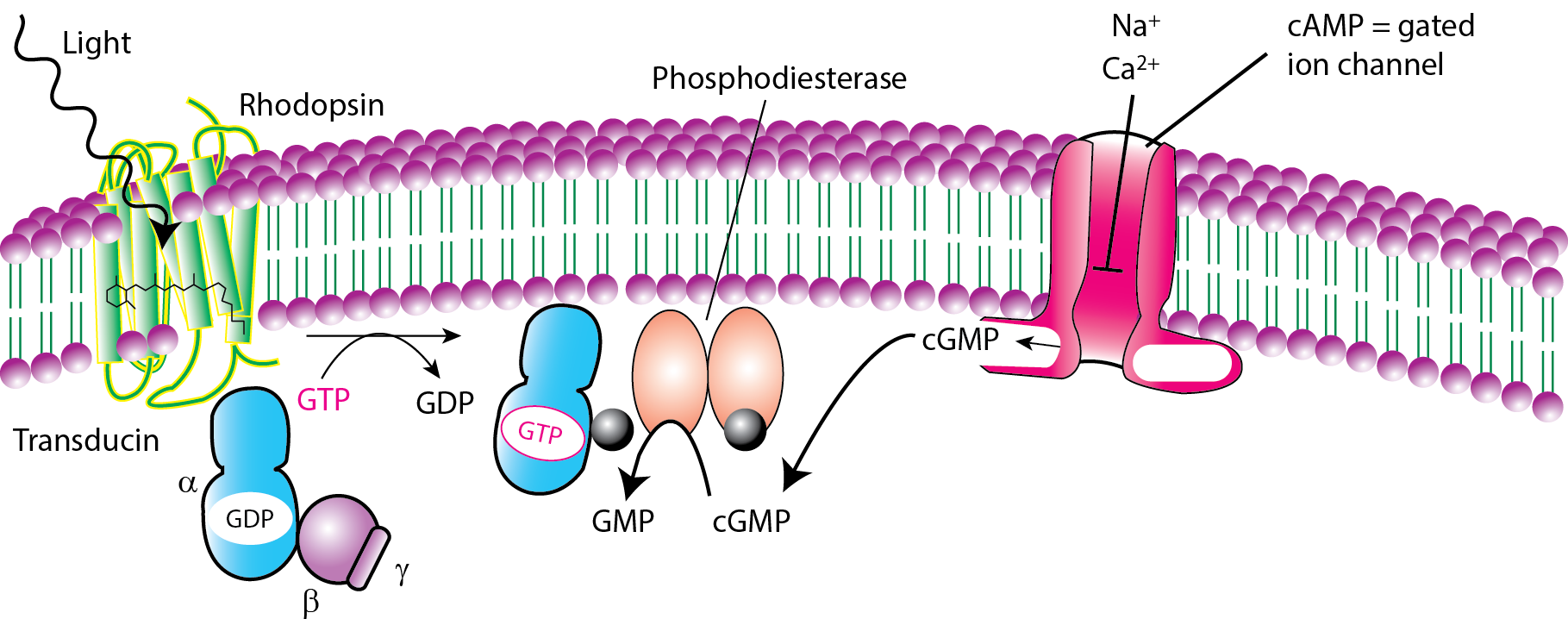
Figure 3: Visual Signal Transduction. The light-induced activation of rhodopsin leads to the hydrolysis of cGMP, which in turn leads to ion channel closing and the initiation of an action potential.