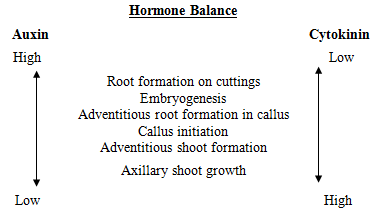
Cytokinin by itself does not induce vascular tissues, but in the presence of IAA, cytokinin promotes vascular differentiation and regeneration. Cytokinin, which promotes cell divisions in the vascular tissues, is a limiting and controlling factor that increases the number of xylem fibers in tissue culture and along the plant axis. In tissue cultures, low IAA concentrations induce sieve elements but not tracheary elements, whereas high IAA concentrations resulted in the differentiation of both phloem and xylem. However, even in cultures grown at a high IAA concentration, only phloem developed at the surface further away from the high auxin-containing medium. Abscisic acid, ethylene, gibberellins, and other hormone-like compounds have regulatory roles which cannot be ignored in tissue culture. For instance, although abscisic acid, ethylene and gibberellins are not added to cultured cells to ensure organogenesis or cell proliferation, these hormones are synthesized in the tissues and are playing an active, but hidden role in growth and development of the plant tissues.
Plant hormones do not function in isolation within the plant body, but, instead, function in relation to each other. Hormone balance is apparently more important than the absolute concentration of any one hormone. Both cell division and cell expansion occur in actively dividing tissue, therefore cytokinin and auxin balance plays a role in the overall growth of plant tissue.
Interesting facts:
- The first plant hormone to be discovered is Auxin.
- The first cytokinin to be discovered was the synthetic analog kinetin.
- Ethylene is also known as ‘ripening hormone’ or ‘death hormone’.