Giant chromosomes:
Some cells at certain particular stage of their life cycle contain large nuclei with giant or large sized chromosomes. Polytene and lampbrush chromosomes are examples of giant chromosomes.
Polytene Chromosome
Giant chromosomes were first time observed by E.G. Balbiani in the year 1881 in nuclei of certain secretory cells (salivary glands) of Chironomas larvae (Diptera). However he could not conclude them to be chromosomes. They were conclusively reported for the first time in insect cells (Drosophila) by Theophilus Painter of the University of Texas in the year 1933. Since they were discovered in the salivary glands of insects they were termed as salivary gland chromosomes. The anme polytene chromosome was proposed by Kollar due to the occurrence of many chromonemata (DNA) in them. Cells in the larval salivary gland of Drosophila, mosquito and Chironema contain chromosomes with high DNA content. However they may also occur in malphigian tubules, rectum, gut, foot pads, fat bodies, ovarian nurse cells etc. Polyteney of giant chromosomes happens by replication of the chromosomal DNA several times without nuclear division (endomitosis) and the resulting daughter chromatids do not separate but remain aligned side by side. During endomitosis the nuclear envelope does not rupture and no spindle formation takes place. The polytene chromosomes are visible during interphase and prophase of mitosis.
They are about 100 times thicker contain 1000 to 2000 chromosomes, than the chromosomes found in most other cells of the organism. When stained and viewed under compound microscope at 40X magnification they display about 5000 bands. In them the chromomere or the more tightly coiled regions alternate with regions where the DNA fibres are folded loosely. A series of dark transverse bands alternates with clear zones of inter bands. Such individual bands can be correlated with particular genes (Figure 1). About 85% of the DNA in polytene chromosomes is in bands and rest 15% is in inter bands. The cross banding pattern of each polytene chromosome is a constant characteristic within a species and helps in chromosome mapping during cytogenetic studies. In Drosophila melanogaster there are about 5000 bands and 5000 interbands per genome. These chromosomes are not inert cellular objects but dynamic structures in which certain regions become “puffed out” due to active DNA transcription at particular stages of development. These chromosome puffs are also termed Balbiani rings. Puffs may apprear and disappear depending on the production of specific proteins which needs to be secreted in large amounts in the larval saliva. Another peculiarity of the polytene chromosomes is that the paternal and maternal chromosomes remain associated side by side and the phenomenon is termed somatic pairing.
Both polyteney and polyploidy have excess DNA per nucleus, but in the later the new chromosomes are separate from each other. A polytene chromosome of Drosophila salivary glands has about 100 DNA molecules which are arranged side by side and which arise from 10 rounds of DNA replication (210=1024). Chironimus has 16000 DNA molecules in their polytene chromosomes.
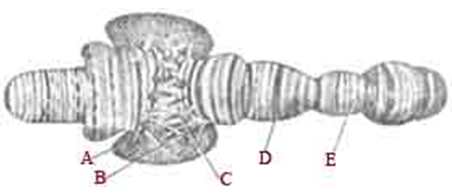
Figure 1: The structure of Drosophilla polytene chromosome. A: mRNA; B-Chromosome puff; C: Chromonemata; D: Dark band; E: Interband. The figure has been adapted from the site http://www.microbiologyprocedure.com/genetics/chromosomes/special-types-of-chromosomes.htm.