3. Vesicles
The vesicles are 60 nm in diameter and are of three types : (i) Transitional vesicles are small membrane limited vesicles which are form as blebs from the transitional ER to migrate and converge to cis face of Golgi, where they coalasce to form new cisternae.
(ii) Secretory vesicles are varied-sized membrane-limited vesicles which discharge from margins of cisternae of Golgi. They, often, occur between the maturing face of Golgi and the plasma membrane.
(iii) Clathrin-coated vesicles are spherical protuberances, about 50 μm in diameter and with a rough surface. They are found at the periphery of the organelle, usually at the ends of single tubules, and are morphologically quite distinct from the secretory vesicles. The clathrin-coated vesicles are known to play a role in intra-cellular traffic of membranes and of secretory products.
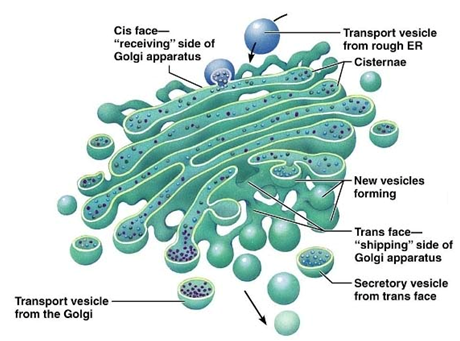
Figure 5: The Golgi complex.
Functions:
1. Modifying, sorting, and packaging of macromolecules for cell secretion: The golgi complex is involved in the transport of lipids around the cell, and the creation of lysosomes. Proteins are modified by enzymes in cisternae by glycosylation and phosphorylation by identifying the signal sequence of the protein in question. For example, the Golgi apparatus adds a mannose-6-phosphate label to proteins destined for lysosomes. One molecule that is phosphorylated in the Golgi is Apolipoprotein, which forms a molecule known as VLDL that is a constituent of blood serum. The phosphorylation of these molecules is important to help aid in their sorting for secretion into the blood serum.
2. Proteoglycans and carbohydrate synthesis: This includes the production of glycosaminoglycans (GAGs), long unbranched polysaccharides which the Golgi then attaches to a protein synthesised in the endoplasmic reticulum to form proteoglycans.
3. Golgi Functions in Animals:
In animals, Golgi apparatus is involved in the packaging and exocytosis of the following: Zymogen of exocrine pancreatic cells; Mucus (a glycoprotein) secretion by goblet cells of intestine; Lactoprotein (casein) secretion by mammary gland cells (Merocrine secretion); Secretion of compounds (thyroglobulins) of thyroxine hormone by thyroid cells; Secretion of tropocollagen and collagen; Formation of melanin granules and other pigments; and Formation of yolk and vitelline membrane of growing primary oocytes. It is also involved in the formation of certain cellular organelles such as plasma membrane, lysosomes, acrosome of spermatozoa and cortical granules of a variety of oocytes.
4. Golgi Functions in Plants:
In plants, Golgi apparatus is mainly involved in the secretion of materials of primary and secondary cell walls (formation and export of glycoproteins, lipids, pectins and monomers for hemicellulose, cellulose, lignin). During cytokinesis of mitosis or meiosis, the vesicles originating from the periphery of Golgi apparatus, coalesce in the phragmoplast area to form a semisolid layer, called cell plate. The unit membrane of Golgi vesicles fuses during cell plate formation and becomes part of plasma membrane of daughter
Interesting Facts:
- George Palade, a Romanian-born naturalized American and cell biologist, was the first to describe free ribosomes.
- An example of an animal cell with many Golgi bodies is an epithelial cell that secretes mucus.
- The cell wall of plant cells is exported to the outside of the membrane by Golgi bodies.