3. Anaphase:
In anaphase, the centromeres divide longitudinally, and the two sister chromatids of each chromosome move toward opposite poles of the spindle. Once the centromere divide, each sister chromatid is treated as a separate chromosome. Chromosome movement results from progressive shortening of the spindle fibers attached to the centromeres, which pulls the chromosomes in opposite directions toward the poles. At the completion of anaphase, the chromosomes lie in two groups near opposite poles of the spindle. Each group contains the same number of chromosomes that was present in the original interphase nucleus.
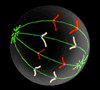
Figure 7: Anaphase
4. Telophase:
In telophase, a nuclear envelope forms around each group of chromosomes, nucleoli are formed, and the spindle disappears. The chromosomes undergo a reversal of condensation until and unless they are no longer visible as discrete entities. The two daughter nuclei slowly goes to interphase stage the cytoplasm of the cell divides into two by means of a gradually deepening furrow around the periphery.
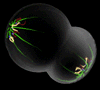
Figure 8: Telophase
5. Cytokinesis:
The chromosomes moved close to the spindle pole regions, and the spindle mid-zone begins to clear. In this middle region of the spindle, a thin line of vesicles begins to accumulate. This vesicle aggregation is an indication to the formation of a new cell wall that will be situated midway along the length of the original cell and hence form boundary between the newly separating daughter cells.
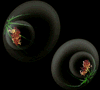
Figure 9: Cytokinesis
Interesting Facts:
- The drug Colchicine arrests cell cycle proression.
- A disregulation of the cell cycle components may lead to tumor formation.
- Several methods can be used to synchronise cell cultures by halting the cell cycle at a particular phase. For example, serum starvation and treatment with thymidine or aphidicolin halt the cell in the G1 phase.
- Some organisms can regenerate body parts by mitosis. For example, starfish regenerate lost arms through mitosis.
- Some organisms produce genetically similar offspring through asexual reproduction. For example, the hydra.
- Although errors in mitosis are rare, the process may go wrong, especially during early cellular divisions in the zygote.
- Endomitosis is a variant of mitosis without nuclear or cellular division, resulting in cells with many copies of the same chromosome occupying a single nucleus.