PROBLEM 2:
Some children are playing with soap bubbles, and you become curious as to the relationship between soap bubble radius and the pressure inside the soap bubble. You reason that the pressure inside the soap bubble must be greater than atmospheric pressure, and that the shell of the soap bubble is under tension, much like the skin of a balloon, You also know that the property surface tension must be important in this problem. Not knowing any other physics, you decide to approach the problem using dimensional analysis. Establish a relationship between pressure difference  , soap bubble radius R, and the surface tension
  of the soap film.
SOLUTION:
The pressure difference between the inside of a soap bubble and the outside air is to be analysed by the method of repeating variables.
Assumptions
1. The soap bubble is neutrally buoyant in the air, and the gravity is not relevant.
2. No other variables or constants are important in this problem.
Analysis: The step by step method of repeating variables is employed.
Step 1: There are three variables and constants in this problem; n=3. They are listed in functional form, with the dependent variable listed as a function of the independent variables and constants: list of relevant parameters:  and n = 3
Step 2: The primary dimensions of each parameter are listed. The dimensions of surface tensions and those of pressure are obtained 

Thus number of pi terms, k = n - j = 3 - 2 = 1. Thus we expect one 
Step3: our two repeating parameters are R and  , since
  is the dependent variable.
Step 4: We combine these repeating parameters into a product with the dependent variable to create the dependent
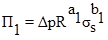 ……………………………………………….(1)
We apply the primary dimensions of step 2 into eq.1 and force the pi to be dimensionless
 .............................. (2)
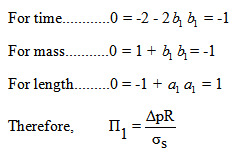
We equate the exponents of each primary dimension to solve for  and
and 
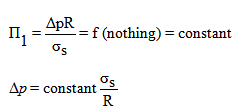
Step 6: We write the functional relationship. In this case there is only one pi, which is a function of nothing. This is possible only if the pi is constant.