Some silent features of a Mach wave are listed below;
- • The series of wave fronts form a disturbance envelope given by a straight line which is tangent to the family of circles. It will be seen that all the disturbance waves lie within a cone (Fig. 4.4.1), having a vertex/apex at the body at time considered. The locus of all the leading surfaces of the waves of this cone is known as Mach cone .
• All disturbances confine inside the Mach cone extending downstream of the moving body is called as zone of action . The region outside the Mach cone and extending upstream is known as zone of silence . The pressure disturbances are largely concentrated in the neighborhood of the Mach cone that forms the outer limit of the zone of action (Fig. 4.4.2).
• The half angle of the Mach cone is called as the Mach angle  that can be easily calculated from the geometry of the Fig. 4.4.1.
 |
(4.4.1) |
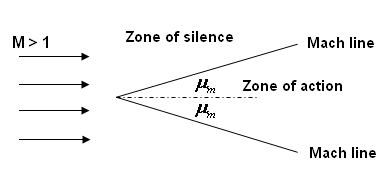
Fig. 4.4.2: Illustration of a Mach wave.
Shock Waves
Let us consider a subsonic and supersonic flow past a body as shown in Fig. 4.3.3. In both the cases, the body acts as an obstruction to the flow and thus there is a change in energy and momentum of the flow. The changes in flow properties are communicated through pressure waves moving at speed of sound everywhere in the flow field (i.e. both upstream and downstream). As shown in Fig. 4.3.3(a), if the incoming stream is subsonic i.e. 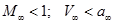 , the sound waves propagate faster than the flow speed and warn the medium about the presence of the body. So, the streamlines approaching the body begin to adjust themselves far upstream and the flow properties change the pattern gradually in the vicinity of the body. In contrast, when the flow is supersonic, (Fig. 4.3.3-b) i.e.
 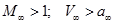 , the sound waves overtake the speed of the body and these weak pressure waves merge themselves ahead of the body leading to compression in the vicinity of the body. In other words, the flow medium gets compressed at a very short distance ahead of the body in a very thin region that may be comparable to the mean free path of the molecules in the medium. Since, these compression waves propagate upstream, so they tend to merge as shock wave . Ahead of the shock wave, the flow has no idea of presence of the body and immediately behind the shock; the flow is subsonic as shown in Fig. 4.3.3(b).
The thermodynamic definition of a shock wave may be written as “the instantaneous compression of the gas”. The energy for compressing the medium, through a shock wave is obtained from the kinetic energy of the flow upstream the shock wave. The reduction in kinetic energy is accounted as heating of the gas to a static temperature above that corresponding to the isentropic compression value. Consequently, in flowing through the shock wave, the gas experiences a decrease in its available energy and accordingly, an increase in entropy. So, the compression through a shock wave is considered as an irreversible process.
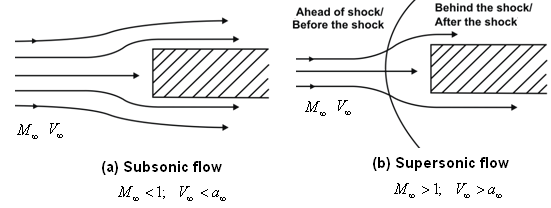
Fig. 4.4.3: Illustration of shock wave phenomena.