Steady Flow Adiabatic Ellipse
It is an ellipse in which all the points have same total energies. Each point differs from the other owing to relative proportions of thermal and kinetic energies corresponding to different Mach numbers. Now, rewrite Eq. (4.3.3) by replacing 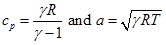 ;
;
 |
(4.3.18) |
When,  so that the constant appearing in Eq. (4.3.18) can be considered as,
  . Then, Eq. (4.3.18) is written as follows;
 |
(4.3.19) |
Replacing the value of  from Eq. (4.3.16) in Eq. (4.3.19), one can write the following expression;
 |
(4.3.20) |
This is the equation of an ellipse with major axis as  and minor axis as
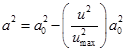
  as shown in Fig. 4.3.3. Now, rearrange Eq. (4.3.20) in the following form;
 |
(4.3.21) |
Now, differentiate Eq. (4.3.21) with respect to u and simplify;
 |
(4.3.22) |
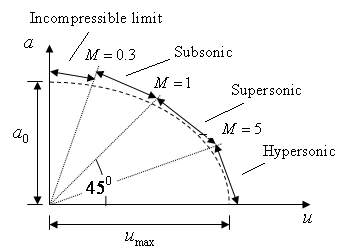
Fig. 4.3.3: Steady flow adiabatic ellipse.
Thus, the change of slope from point to point on the ellipse indicates the change in Mach number and hence the speed of sound and velocity. So, it gives the direct comparison of the relative magnitudes of thermal and kinetic energies. Different compressible flow regimes can be obtained with the knowledge of slope in Fig. 4.3.2. The following important inferences may be drawn;
- • In high Mach numbers flows, the changes in Mach number are mainly due to the changes in speed of sound.
• At low Mach numbers flows, the changes in Mach number are mainly due to the changes in the velocity.
• When the flow Mach number is below 0.3, the changes in speed of sound is negligible small and the flow is treated as incompressible.