An isentropic process provides the useful standard for comparing various types of flow with that of an idealized one. Essentially, it is the process where all types of frictional effects are neglected and no heat addition takes place. Thus, the process is considered as reversible and adiabatic. With this useful assumption, many fundamental relations are obtained and some of them are discussed here.
Stagnation/Total Conditions
When a moving fluid is decelerated isentropically to reach zero speed, then the thermodynamic state is referred to as stagnation/total condition/state. For example, a gas contained in a high pressure cylinder has no velocity and the thermodynamic state is known as stagnation/total condition (Fig. 4.3.1-a). In a real flow field, if the actual conditions of pressure (p), temperature (T), density (ρ), enthalpy (h), internal energy (e), entropy (s) etc. are referred to as static conditions while the associated stagnation parameters are denoted as  , respectively. The stagnation state is fixed by using second law of thermodynamics where
  as represented in enthalpy-entropy diagram called as the Mollier diagram (Fig. 4.3.1-b).
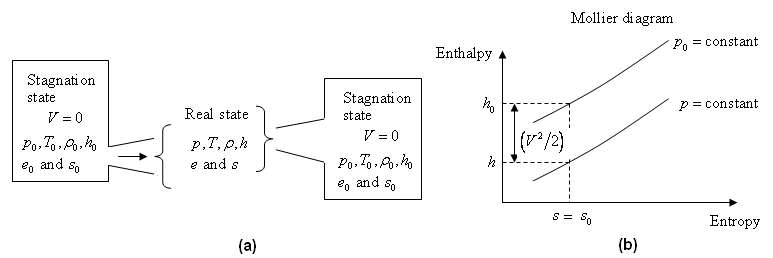
Fig 4.3.1: (a) Schematic representation of stagnation condition; (b) Mollier diagram.
The simplified form of energy equation for steady, one-dimensional flow with no heat addition, across two regions 1 and 2 of a control volume is given by,
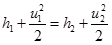 |
(4.3.1) |
For a calorically perfect gas, replacing,  , so the Eq. (4.3.1) becomes,
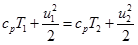 |
(4.3.2) |
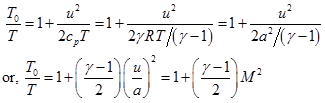
If the region ‘1' refers to any arbitrary real state in the flow field and the region ‘2' refers to stagnation condition, then Eq. (4.3.2) becomes,
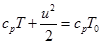 |
(4.3.3) |
It can be solved for  as,
as,
 |
(4.3.4) |
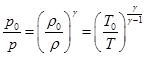
For an isentropic process, the thermodynamic relation is given by,
 |
(4.3.5) |
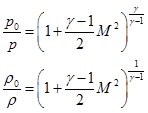
From, Eqs (4.3.4) and (4.3.5), the following relations may be obtained for stagnation pressure and density.
 |
(4.3.6) |
In general, if the flow field is isentropic throughout, the stagnation properties are constant at every point in the flow. However, if the flow in the regions ‘1' and ‘2' is non-adiabatic and irreversibile, then 