Use the following trigonometric relations in Eq. (3.8.16);
 |
(3.8.17) |
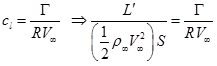
The lift coefficient can be obtained as,
 |
(3.8.18) |
The value of lift per unit span  can be obtained by considering the plan-form area S = 2R in Eq. (3.8.18) and after simplification, one can obtain,
 |
(3.8.19) |
It is seen from Eq.(3.8.19) that the lift per unit span for a circular cylinder in a given free stream flow is directly proportional to the circulation. This simple and powerful relation is known as Kutta-Joukowski theorem. This result shows the importance of the concept circulation and the same result can be extended for two-dimensional bodies. The inviscid potential flow does not provide proper explanation for drag calculation because zero drag in a flow field is quite un-realistic. Because of viscous effects the flow separates from the rear part of the cylinder, creating recirculating flow in the wake downstream of the body. This separated flow greatly contributes the finite drag measured for the cylinder. However, the prediction of lift by Kutta-Joukowski theorem is quite realistic.
Magnus Effect
The general idea of generation of lift for a spinning circular cylinder can be extended to sphere. Here, non-symmetric flows are generated due to spinning of bodies in all dimensions. It leads to the generation of aerodynamic force perpendicular to the body's angular velocity vector. This phenomenon is called as Magnus effect . The typical examples include the spinning of three-dimensional object such as soccer, tennis and golf balls where the side force is experienced.