·
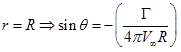
In order to locate the stagnation points, one can put  in Eq. (3.8.4) and solve for resulting coordinates
  :
:
 |
(3.8.5) |
Since  is a positive number, the value of θ must be lie in the range
  and there are three possibilities;
Case I: If  , then the two stagnation points are shown by the points ‘A and B' lies in the bottom half of the cylinder as shown in Fig. 3.8.2. The locations of these points are given by the Eq. (3.8.5).
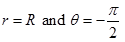
Case II: If  , then there is one stagnation point on the surface of the cylinder at the point ‘C' as shown in Fig. 3.8.2. It means that the point ‘A and B' come closer meet at point ‘C' on the surface at
  .
.
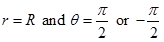
Case III : When,  , no interpretation can be made from Eq. (3.8.5). Referring to Eq. (3.8.4), the stagnation point
  is satisfied for both
  . Now, substitute
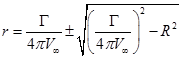
  in Eq. (3.8.4) and solve for r by setting
  at the stagnation point.
 |
(3.8.6) |
Eq. (3.8.6) is a quadratic equation and the two possible solutions can be interpreted as stagnation points: one lies inside the cylinder (point ‘D') and other lies outside the cylinder (point ‘E') as shown in Fig. 3.8.2. Physically, the point ‘D' is generated within the cylinder  , when a doublet flow at origin is superimposed on a vortex flow while the point ‘E' lies on same vertical axis for
  .
.
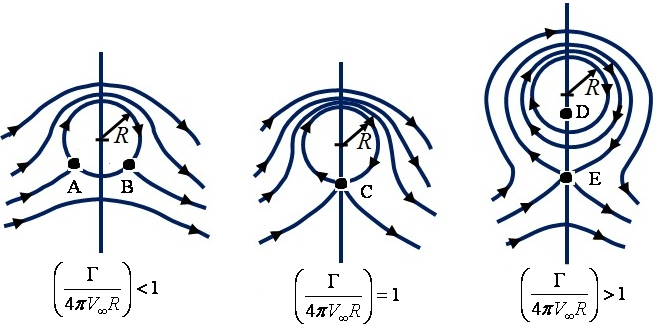
Fig. 3.8.2: Stagnation points for lifting flow over a cylinder.