Based on the results shown in Fig. 3.8.2, the following inferences can be made;
- • The circular streamline
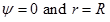 is one of the allowed streamline in the synthesized flow field that divides the doublet flow and vortex flow. So, one can replace it as a solid body i.e. circular cylinder and the external flow will not feel the difference. The free stream can be considered as a vortex flow.
• With reference to the solid body, the stagnation point ‘D' has no meaning and only point ‘E” is the meaningful stagnation point.
• Since, the parameter  can be chosen freely, there are infinite numbers of possible potential flow solutions, for incompressible flow over a circular cylinder. This is also true for incompressible potential flows over all smooth two-dimensional bodies.
Lift and Drag Coefficients for Circular Cylinder
Intuitively, one can say that there is a finite normal force when a circular cylinder is placed in a vortex flow while the drag is zero i.e. d'Alembert's paradox still prevails. Let us quantify the results;
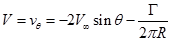
First, the velocity on the surface of the cylinder (r=R) can be written as,
 |
(3.8.7) |
The pressure coefficient is obtained as,
 |
(3.8.8) |
The force coefficients can be obtained by integrating pressure coefficient and skin friction coefficient over the surface. For the inviscid flow, there is no skin friction coefficient. Hence, the drag coefficient is written as,
 |
(3.8.9) |