Steady Flow Energy Equation vs Bernoulli Equation
In general, the steady flow energy equation is applied to the control volumes with one-dimensional inlets and outlets. Often, in many situations, it is not strictly one-dimensional rather velocity may vary over the cross-section. So, the kinetic energy term in Eq. (2.4.6) can be modified by introducing a dimensionless correction factor  so that the integral can be proportional to the square of the average velocity through the control surface for an incompressible flow.
 |
(2.4.18) |
If u is the velocity normal to the control surface, then the integral can be evaluated to obtain the expression of α known as kinetic energy correction factor.
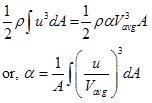 |
(2.4.19) |
So, the general form of steady flow energy equation for an incompressible flow can be obtained from Eq. (2.4.8) by using the parameter α.
 |
(2.4.20) |
This relation (Eq. 2.2.20) involves the terms that accounts for friction, heat transfer, shaft work and any viscous dissipation. In contrast, the strict restrictions are imposed Bernoulli's equation (Eq. 2.4.17) that can be listed as follows;
- • Steady, incompressible and frictionless flow
• Flow along a single streamline because different streamlines may have different Bernoulli constant.
• Flow with one inlet and outlet
• No shaft work and heat transfer between the sections.