Combined Equation (First and Second Law of Thermodynamics)
Let us revisit the following equations derived in the previous section from the statements of first and second law of thermodynamics.
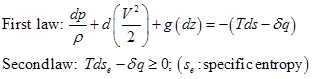 |
(2.4.1) |
Combination of first and second law of thermodynamics leads to,
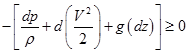 |
(2.4.2) |
Introducing the equality sign, Eq. (2.4.2) can be rewritten as,
 |
(2.4.3) |
The equality sign in Eq. (2.4.2) holds good for any steady and reversible (i.e. frictionless) while the inequality sign exists for all steady and irreversible flow involving friction. The extent to which the loss of useful/available energy occurs is mainly due to the irreversible flow phenomena including viscous effects. If some shaft work is involved, then the resulting equation becomes,
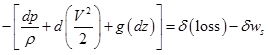 |
(2.4.4) |
Both the Eqs (2.4.3 & 2.4.4) are valid for compressible and incompressible flows. In the case of frictionless and steady flows, the combined first and second law leads to the following equation;
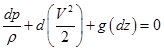 |
(2.4.5) |