·
Steady Flow Energy Equation (SFEE)
Let us recall the following energy equation derived in the previous section;
 |
(2.4.6) |
The general form of one-dimensional steady flow energy equation may be obtained from Eq. (2.4.6) and it has lot of engineering applications. If there is one inlet (section 1) and one outlet (section 2), then the first term in Eq. (2.4.6) can be omitted and the summation term in Eq. (2.4.6) reduces to single inlet and outlet.
 |
(2.4.7) |
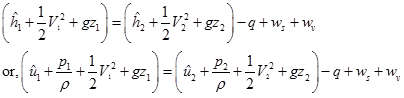
Since mass flow rate is constant, the continuity equation becomes  . So, the terms in Eq. (2.4.7) can be rearranged as follows;
 |
(2.4.8) |
Here, the terms  refer to heat and work transferred to the fluid per unit mass and
 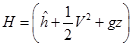 is the stagnation enthalpy. Eq. (2.4.8) is known as the steady flow energy equation (SFEE) . Each term in this equation has the dimensions of energy per unit mass. The other way to represent this equation is in the form energy head which is obtained by dividing both sides with the term g (i.e. acceleration due to gravity). So, the other form of Eq. (2.4.8) is given by,
 |
(2.4.9) |
where,  are the head forms of heat and work transfers. The terms
 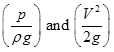 are called as pressure head and velocity head , respectively.
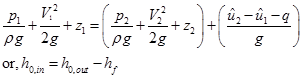
- A very common application of SFEE is the low-speed flows with no shaft work and negligible viscous dissipation such as liquid flow through pipes. In such cases, Eq. (2.4.9) may be written as,
 |
(2.4.10) |
Here, the terms  are called as available/total head at the inlets and outlets, respectively and hf is the loss in head due to friction.