29.1 Introduction
While deriving the special governing equations for the boundary layer, we have assumed the boundary layer thickness to be very small where viscous effects are confined. This assumption in turn specifies that the outer inviscid flow remain unaffected in the presence of the boundary layer. However hypersonic flows regime has trait of large boundary layer thickness where outer inviscid flow gets partly or strongly affected in the presence of thick boundary layer. Changes in outer inviscid flow leads to further changes in boundary layer characteristics and hence provides a feed back to the inviscid flow again. This interaction of outer inviscid flow with the boundary layer is called as viscous interaction. This interaction can be mainly of two types. In one of the interactions, exceptionally thick boundary layer grows over the surface. This interaction is termed as pressure interaction; however this interaction is prominently referred as viscous interaction. In the other interaction, shock impingement takes place on the body due to which boundary layer gets disturbed or even separated depending upon the thickness of the boundary layer and strength of the shock.
Viscous interaction is generally characterized as strong or weak interaction depending upon its effect on the wall properties, outer inviscid flow and growth of boundary layer thickness. Strong interaction region is immediately downstream of the leading edge, where the rate of growth of boundary layer thickness is high as shown in Fig.29.1. This is the main reason of reception of large deflection to the streamlines which in turn increases the strength of the shock wave. Higher value of wall pressure at the leading edge in comparison of the corresponding inviscid wall pressure (Fig. 29.2) is the immediate effect of the same strong interaction between outer inviscid flow and viscous flow in the thick boundary layer.
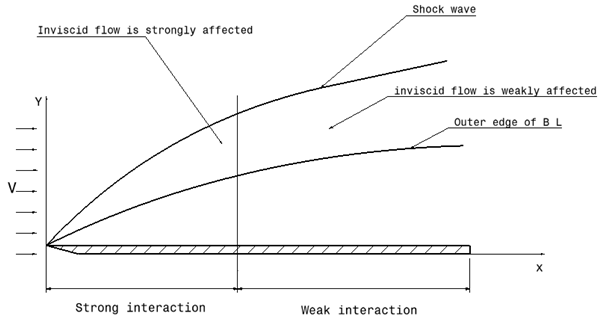
Fig.29.1 Strong and weak interaction regions for hypersonic flow over flat plate.