Carbohydrate (Part-II)
Kreb Cycle: Kreb Cycle is discovered by professor Hans Kreb and as it has all sugar intermediates with three carbon. it is also known as tricarboxylic acid or citric acid cycle. In higher eukaryotes, kreb cycle operates inside the mitochondrial stroma with the different enzymes. In the presence of oxygen, pyruvate formed during glycolysis enters into the kreb cycle for further oxidation to produce energy. But pyruvate can not enter directly into the kreb cycle, instead it needs further activation to form acetyl co-A.
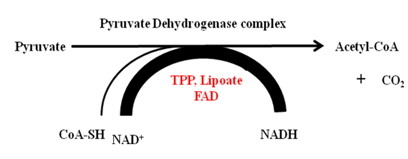
Production of Acetyl-CoA: it is a oxidative decarboxylation from pyruvate to release CO2 and generation of acetyl coA and reducing equivalent NADH. It is an irreversible reaction catalyzed by pyruvate dehydrogenase complex. Similar to glycolysis, irreversible decarboxylation commits the pyruvate for kreb cycle. In addition, acetyl-CoA is the reaction intermediate in fat metabolism and works as feeder point for kreb cycle (discussed more later).
Acetyl-CoA enters into the kreb cycle and undergoes a chain of 8 different reactions to produce energy. These steps are given in Figure 37.1.
STEP 1: Formation of citric acid- This reaction is catalyzed by citrate synthase where acetyl coA condense with oxaloacetate to form citric acid. During the reaction, citronyl-CoA is produced due to joining of acetyl CoA and oxaloacetate. This high energy intermediate undergoes hydrolysis to form citrate.
STEP 2: Formation of isocitrate- The reversible transformation of citrate to isocitrate with cis-aconitate as an intermediate.This reaction is catalyzed by aconitase.
STEP 3: Oxidation of Isocitrate to α-keto glutarate- This is the first step of kreb cycle where CO2 is produced with an additional oxidative decarboxylation of iso-citrate to form α-keto glutarate catalyzed by isocitrate dehydrogenase. One molecule of NADH is generated which will give 3 ATP molecule after oxidative phosphorylation.