Thus, for a given non zero complex number  , its modulus
  and argument
  can be computed so that
  can be represented as
  . This representation is called the polar representation of
  , and the values of
  and
and  are called polar coordinates of
  . Writing
  as
as 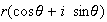 is known as the trigonometric form of the complex number
  .
.
For the complex number  , the modulus is
  , but the argument is undefined .
If a complex number  is written in the polar form or in the trigonometric form then it is understood that it is a non-zero complex number.
For each non-zero  , there is only one value of
  say
say  satisfying
  . This value will henceforth be denoted by
  and is called the principal value of
  . We can establish the relation between
  and
and  :
:
