Polar form of complex numbers: Each point  of the complex plane, other than the origin, determines a directed segment of geometric vector
  (called its position vector), with origin
  and endpoint
  , and conversely. The point
  will be associated with the null vector
  .
.
Let  be the point corresponding to the non-zero complex number
  in the plane. let
  be the projection of
  upon the coordinate axis
  and
and  be the projection of
  upon the coordinate axis
  . Denoting the signed measures of
  and
and  , by
, by  and
and  , we have
  and
and  . (That is, if
  , then
  and
and  ). The length
  of the vector
  is given by
 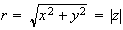 . The measure
  in radians of the oriented angle from the positive real axis to the vector
  is called the argument or the amplitude of the vector
  , and we write
  .
.
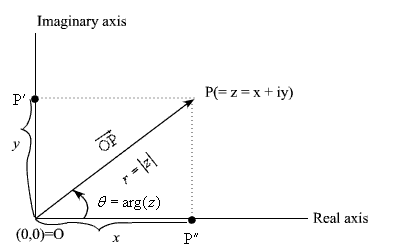
Figure 3
From trigonometry we have,  and
and  . Thus, the number
  is determined only up to multiples of
  and the set of all such angles is denoted by
  . However all the values in this set represent the same direction in the complex plane. For example, an argument of the point
  is
is  and all the values of argument of
  are given by
 where
where  is any integer.