| SOCIAL, IMPLICATIONS OF WASTE MANAGEMENT |
Introduction
Waste Management (WM) is a dynamically emerging field with vaste scope. The growing urbanization and industrialization is making WM a complex problem with serious sociological, ecological and economic implications. A sustained effort is needed to restore the socio-ecological balance of nature in order to optimally harness the available resources.
This paper emphasizes to deal with the problem of waste in totality considering its technical as well as social aspects and highlighting the social implications of effective WM. A sort of social cost-benefit analysis should be done prior to the implementation of any W M programme. It has been emphasized that in the socio-economic resource structure of India, Management of waste plays an important role.
Waste Management: An Overview
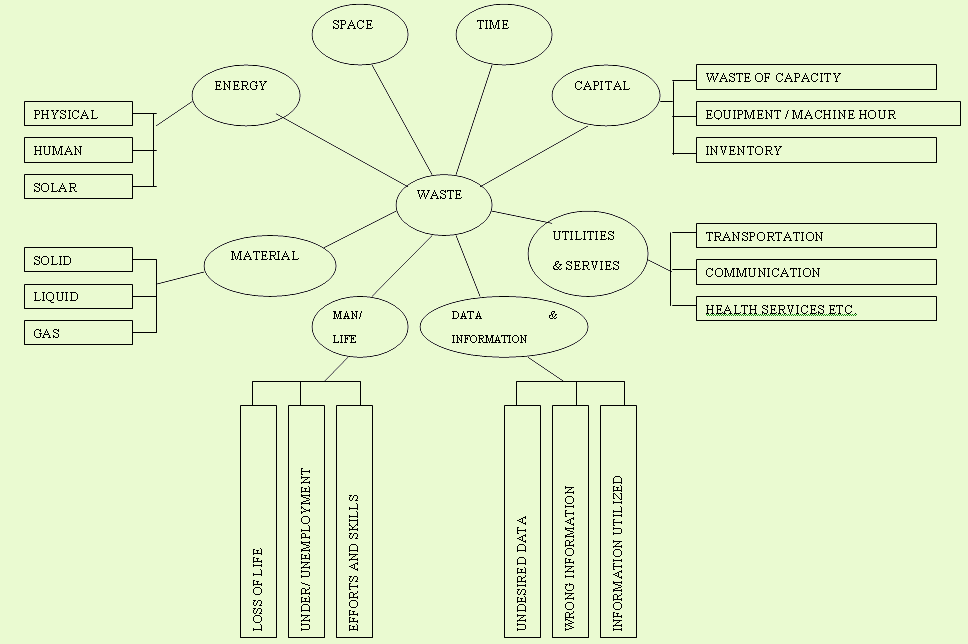
From system's view point, waste has been visualized as any unnecessary input to or any undesirable output from any system encompassing all types of resources, viz., manpower, material energy, space, time, capital, utilities and services, data and information etc. The resource-based classification of waste is shown in Figure 1. Waste Management (WM) is conceptualized as a multidisciplinary activity to minimize the overall wastivity of the system under consideration (1, 2, and 5). A systematic approach to WM encompassing the waste of all kinds of resources at all stages should be adopted. However, as the material constitutes a major faction of the total product cost, material wastes are of critical importance.
Complementarity of Waste Management and Resource Management
A system basically takes some input, process it and gives the desired output, as shown in Figure 2 i.e., some input is essential, in whatever form, for the functioning of a system. An ideal system is conceptualized to transform the total input into useful or desirable output. In view of the known physical laws of nature the existence of an ideal system is not possible, i.e. 100 per cent utilization of resources is not practically possible for any system. To paraphrase, some waste is inevitable in the functioning of any system.
The main objective of WM is to minimize the waste this aiming at the ideal system, while the resource management aims to maximize the utilization of the resources. The goal of waste and resource management is same, i.e., optimal utilization of the available resources for higher efficiency and growth of the system, but the approaches are different. The relationship of waste and resource management is shown in Figure 3. It can be said that waste and resource management are complementary to each other. If one is primal formulation of a problem, the other is dual.
Concept of Wastivity
An ideal or perfect system will be one that consumes just the right amount of resources, leaving no idle, unutilized (nonrecoverable) or lost resource, or any undesirable output. The concept of "wastivity" which is yet in the rudimentary stages may prove to be a good measure of performance, both at macro and micro levels, and will be helpful in the sound planning and monitoring of various systems at different levels of hierarchy.
"Wastivity of any system is defined as the ratio of the waste to the input"?
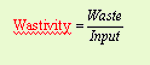
Depending upon the level of waste under consideration the wastivity may be categorized as gross wastivity and net wastivity. The wastivity for each type of input indirectly assesses the productivity of each type of input. Both productivity and wastivity are complementary to each other, which bears in it the inherent cause-effect phenomenon. The cause, i.e. wastivity is checked, the effect, i.e. productivity, will automatically be improved.
The Functional Elements of Waste Management
The problems associated with the management of waste in today's society are complex and diverse in nature. For an effective and orderly management of wastes the fundamental aspects and relationships must be identified and clearly understood. The efficient WM comprises the guide identification of waste generated/caused, economic reduction, efficient collection and handling, optimal sense and recycling, and effective disposal of waste leaving no environmental problems. WM can thus be functionally classified into five basic elements, viz., generation, reduction collection, recycling and disposal. However, Waste Management (WM) should be viewed in totality considering the inter-relationship of basic functional elements/ systems as shown in Figure 4. One of the objectives of WM is to optimise these basic functional systems to provide the most efficient and economic solution, commensurate with the constraints imposed.
By considering each element separately it is possible to:
(i) Identify the fundamental aspects and relationships involved
in each element:
(ii) Develop, wherever possible, quantifiable relationships for the purpose
of making engineering comparisons, analysis and evaluation.
Socio-economic Benefits of Waste Management Programmes
Some of the social and economic benefits of effective WM programmes and systems are as follows:
i. Cheaper products due to increased productivity. Reduced
scarcity of materials by way of material conservations.
ii. Economic gains by salvaging waste materials.
iii. Introduction of newer products by recycling/reusing wastes.
iv. Relief from energy crisis.
v. More hygienic, safe and pollution free environment.
vi. Lesser public nuisance due to reduction in diseases.
vii. Neat, clean and comfortable living conditions and higher standard
of living.
viii. Reduced uncertainty, better prediction and control of natural calamities
by nature conservation.
ix. Preservation of heritage, fauna and flora.
x. Control over unemployment and the development of a healthier society,
and.
xi. Speedier and sustained national development and self-reliance.
Development of Economic System
Many a time growth and development of the economic system are treated as synonymous. The consumption of resources is considered a growth measure. More consumption does not necessarily mean more development. The development of the economic system is dependent upon the effectiveness of utilization of the inputs, which is very much related to the management of waste in the economy. It is advocated here that the waste parameters deserve explicit consideration in view of their important role in various systems. The need to incorporate waste as a parameter in socio-economic planning can hardly be overemphasized by taking into consideration the crisis of vita fly needed resources, balanced economic growth of the nation, and the awareness for a cleaner and hygienic ****
The techno-economic structure has conventionally been concentrating on intermediate means and intermediate ends. The ultimate means and ultimate ends in the spectrum, as shown in Figure 5, (4) have most of the time been ignored. This has led to serious social as well as ecological problems at both the ends. In order to minimize such socio-ecological problems the base has to be widened to incorporate the ultimate means as well as the ultimate end. WM can provide answer to interlink various stages from the ultimate means to the ultimate ends in an effective manner.
he low entropy resources are being consumed exorbitantly and in the process high entropy wastes are generated. This is leading to a continuous increase of the entropy of the whole socio-economic system. This rate of growth of entropy has to be checked if the human race wants to survive for tong and at a higher level of development. The entropy can be brought under control by managing the waste in the economic system effectively. The technology and WM can be taken as a substitute of negentropy, (3) as the technological progress enables the economic extraction of lower grade natural resources and improved technology and WM result in lower wastivity of the economy.
Socio-Technical System
From socio-technical system's viewpoint every organization is an integrated system having interacting technical and social sub-systems as shown in Figure 6. The organization taken both the technical and social inputs, gives the output of technical as well as social nature, and generates both the technical and the social system waste. The relationship of technical and social system waste is shown in Figure 7. The technical system's waste increase the social system's waste and vice versa. Waste, whether technical or social, affects the social system within the system and the environment through the links of quality, productivity and environmental pollution.
In this regard selection of technology is an important managerial consideration. A wrong choice of technology will lead to consequent waste of resources as well as cause social problems. For example; if a capital intensive technology is selected, for a country like India with vast amount of manpower available, in a sector where it is not needed, it will result in the waste of capital, manpower and energy. Managers can play a vital role in the selection of appropriate technology.
Social Responsibilities and Interfacing Problems
It is the social responsibility of every scientist, technologist and manager to design and manage systems which are leading to minimum level of wastivity as shown in Figure 8. There are two sub-systems in the technology cycle. One is technology development system and the other is technology management system. Scientists, technologists and managers have their social responsibilities with respect to both the systems. However, the scientists and technologists have higher responsibilities for the technology development system, whereas the managers are more responsible for the technology management system.Scientists and technologists fulfil their social responsibilities by designing and developing technologies that minimize the wastivity, and there, meet the social needs of the system and the environment in the best possible manner.
Manager's social responsibilities are also very wide, and by managing the system's waste they contribute towards better performance of social system by obviating some interfacing socio-economic problems such as resource crisis, environmental pollution, psychological and social stresses.
Conclusion
The need and importance of WM in the socio-economic system has been
emphasized and the social implications of effective WM are highlighted.
It is concluded that in order to create awareness in this regard the
engineering curricula should incorporate some topics on systems approach
to WM and its socio-economic implications. It is hoped that, if the
professionals come out of the narrow conventional approach to WM and
adopt a broader systems approach to WM, it will help in the development
of a better socio-economic
Paper presented in the curriculum Development Workshop, New Delhi on Social Responsibilities of Scientists, Technologists. Co-ordinator Prof Anuradha Sharam & Prof Raka Sharan.
Many industries in India have also developed various technologies for
disposal of waste, for e.g. Solid wastes and Fly ash etc has been discussed
in this paper.
* Click here to have an idea about such technologies in one of the companies.
Further Waste Management analysis
We have discussed the issues related to waste management in our earlier
modules. These also constitute future challenges for us. In response
to government and public pressures, the health care industry has in
the past few years directed a significant effort toward the proper and
safe management of medical waste streams. Medical waste is classified
as a bio hazardous waste which may result in human infection and transfers
of disease. This also includes injury and infection with many viruses
and the Humans Immunodeficiency Virus to laundry workers, nurses, emergency
personnel, and refuse workers who may come into contact with medical
waste.
In a recent survey conducted in the United States and Japan and reported by the world health organization (WHO) (1994), it was found that injuries by sharps constitute about 1-2 % per annum for nurses and maintenance workers and 18 % per annum for outside waste management workers. In Japan, the survey indicated that injuries by sharps constitute about 67% for in hospital waste handlers and 44% for outside waste management workers.
In order to reduce the risks associated with medical waste, proper management mechanism should be adopted by health care facilities to protect the health of the staff within the medical facility, waste collection workers and the public once the waste has left the facility for final disposal. These mechanisms include.
- Waste identification
- Segregation
- Storage and
- Treatment
However, as a first-step in the implementation of a waste management system, the management of a medical facility should conduct an audit of the generated waste streams. The purpose of this audit is to specify the locations of the waste generation points and types and amounts of generated waste. An accurate estimate of the medical waste amounts provides the management of a health care facility the tools for.
1. Predicting the cost of operating its medical waste management system in relation to the fees for waste transport, treatment and disposal.
2. Improving environmental performance by monitoring the amounts of generated waste from each medical activity, and undertaking proper measures to enforce waste quantity minimization.
WHO/ UNEP (1997), the World Health Organization has adopted the following definitions.
· Medical activities: - any practices related to the diagnosis, monitoring, treatment or prevention of disease or alleviation of handicap in human or animals. These include emergency services, nursing, dental, veterinary, pharmaceutical or similar practices, investigation, teaching and research, or the collection of blood for transfusion.
· Medical waste: the total waste streams arising form medical activities which consist wholly or partly human or animal tissue, blood or other bodily fluids, excretions, drugs or other pharmaceutical products, swabs or dressings, or syringes, needles or other sharp instruments, being waste which unless rendered safe, may prove hazardous or infectious to any person coming into contact with it.
· Healthcare or medical facilities: the sites carrying out all kinds of medical activities as defined above. These include, but not limited to, hospitals, healthcare centres, medical and dental clinics, laboratories, blood banks, pharmacies etc.
The WHO regional guidelines (1994) presents some examples of heath care
waste classification systems in the western pacific countries. Accordingly
a sound approach for classifying wastes for the purposes of determining
their quantities is to adopt classification system which corresponds to
the locally implemented methods for waste collection, treatment and disposal.
Waste management and sustainable development:
Kofi A Anan (2002) observed Sustainable development rests
on three pillars: economic growth, social progress and protection of our
environment and natural resources. When the idea first burst onto the
scene in 1987 with the publication of our common future, it was meant
to go beyond the ecosystem approaches of the past, which put environmental
issues on the political map but did not take fully into account these
other key concerns.
Despite this advance, and despite considerable efforts and significant
achievements since the "Earth summit "the latest readings reveal
a planet still in need of intensive care. Poverty, pollution and population
growth; rural poverty and rapid urbanization; wasteful consumption habits
and growing demands for water, land and energy continue to place intense
pressures on the planet's life support systems, threatening our ability
to achieve sustainable development.
There is little chance of protecting the environment without a greater
sense of mutual responsibility, especially in an age of interdependence,
and especially since the environmental "footprint" left by some
societies is so much larger than that left by others.
Leadership qualities coupled with technical competence are a potent prescription for engineers and managers shouldering the heavy responsibility of socio-economic development of the country. Corporations are driven by vast engine of consumer satisfaction; many are also responsible for environmental destruction. Corporations and businesses also generate pollution, contributing to what has been called the "trash crisis".
They have not only been accused of generating trust, but also environmental racism, a charge that turns our attention to where that trash is going and has gone. According to Benjaarn F-Charis Jr. "a deliberate getting people of color communities for toxic waste facilities" and an "official sanctioning of the life- threatening presence of poisons and pollutants in our communities". Minorities bear a greater burden form lead poisoning airborne toxins and contaminated drinking water. Says Deeohn Ferris an attorney for the National Wildlife Federation.
The condition is called as "environmental racism" an environmental researcher hope Taylor says "small dirty industries have a tendency to locate in minority communities for two reasons; one is cheap labor and two relative lack of knowledge about environmental concerns ".
Environmental Racism analyzes the pattern of placing hazardous facilities in communities in many countries and also makes a connection between this phenomenon and dumping hazardous wastes in third - world countries often a discussion of ethics in business or corporate social responsibility is reduced to a stank conflict between making profits for shareholders vs. assuming social responsibilities to the entire community (Grossman, 1971)
Milton Friedman (1970) a Nobel Prize economist raises the question whether business has social responsibilities? Some business people have expressed the view that they ought to not merely be concerned with maximizing profits but also concerned about "discrimination" and "Avoiding pollution". According to Friedman corporations have "artificial responsibilities "but not "but as a whole". He argues that they are employees of stakeholders and that their duty is to make as much money as possible comparable with the "basic rules of the society "those embodied in law and those embodies in ethical custom. The executive is thus just an agent of those who own the corporation and his primary responsibility is to them. He must not make corporate decisions in manners that does not promote " the best interests of his employers" and if he does he is spending someone else's money to promote a "social objective and this in Friedman's view amounts to fixation a function reserved in our political system to the government. If an executive so acts, he is taxing people without being represented. Fried man thinks this is typical or socialism. He claims that executives may lack expertise to make such decisions, for e.g., how to might inflation or to ascertain how much stakeholders advocate pursuit of social objectives.
There is a counter argument to Friedman's view's that has been given by a legal theorist Christopher Stone. He says that "the managers of the corporation are to be steered almost wholly by profit, rather than what they think proper for society on the whole". Stone takes the position that it may be better to leave the running of corporations to the market and the law rather than "to have corporate managers implementing their own vague and various notions of what is best. However, this view applies only if the law and the market can keep corporations within "desirable bounds" of social responsibilities.
One example of these circumstances is the displacing of third-world farmers by huge agribusiness companies in order to grow crops for export to other countries. Stakeholder is a relatively new term invented to contrast with "Shareholder". This suggests that many individuals and groups beside shareholder are interest groups, retirees, host communities and customers to name a few.
Thus, aims of CRS areas are as follows:
Companies now perform in non-financial arenas such as human rights, business ethics, environmental policies, corporate contributions, community development, corporate governance, and workplace issues.
Social and environmental performances are considered side by side with financial performance. From local economic development concerns to international human rights policies, companies are being held accountable for their actions and their impact.
Companies are also more transparent in disclosing and
communicating their policies and practices as these impact employees,
communities, and the environment.
In the new global economy, companies that are responsive to the demands of all of their stakeholders are arguably better positioned to achieve long-term financial success. It is no longer optional for a company to communicate its environmental and social impacts; such information is pertinent in an information-driven economy, and improved communication has become critical for sustainable business growth.
CSR has become the password to not only overcome competition but to ensure sustainable growth. It has been supported not only by the shareholders but stakeholders by and large encompassing the whole community. Corporate Virtue Is In is the slogan as it offers so many advantages including a hike in profits.
CSR is the point of convergence of various initiatives aimed at ensuring socio-economic development of the community which would be livelihood oriented as a whole in a credible & sustainable manner.
The above discussion suggests that there is Benefits of CSR too. Some of these are presented below:
o Improved financial performance
o Reduced costs
o Enhanced brand image and reputation
o Increased sales and customer loyalty
o Customer satisfaction
o Increased productivity and quality
o Increased ability to attract and retain employees
o Reduced regulatory oversight
o Brand Visibility, recognition and awareness
o Increased market share
o Favourable positioning
o Competitive mileage
o More engaged investors
o Environmental sustainability
o Forging of partnerships
According to Wikipedia encyclopedia, corporate social responsibility (CSR)
is an expression used to describe what some see as a company's obligation
to be sensitive to the needs of all of its stakeholders in its business
operations. The principle is closely linked with the imperative of ensuring
that these operations are "sustainable" i.e. that it is recognized
that it is necessary to take account not only of the financial/economic
dimension in decision making also the social and environmental consequences
"_Sustainable Development"_.
A company's stakeholders are all those who are influenced by and/or can
influence a company's decisions and actions, both locally and globally.
These include (but are not limited to): employees, customers, suppliers,
community organizations, subsidiaries and affiliates, joint venture partners,
local neighborhoods, investors, and shareholders (or a sole owner).
Today's heightened interest in the proper role of businesses in society
has been promoted by increased sensitivity to environmental and ethical
issues. Issues like environmental damage, improper treatment of workers,
and faulty production leading to customers inconvenience or danger, are
highlighted in the media. In some countries Government regulation regarding
environmental and social issues has increased, and standards and laws
are also often set at a supranational level. Some investors and investment
fund managers have begun to take account of a corporation's CSR policy
in making investment decisions. Some consumers have become increasingly
sensitive to the CSR performance of the companies from which they buy
their goods and services. These trends have contributed to the pressure
on companies to operate in an economically, socially and environmentally
sustainable way... Corporations have often, in the past, spent money on
community projects, the endowment of scholarships, and the establishment
of Foundations. They have also often encouraged their employees to volunteer
to take part in community work thereby create goodwill in the community
which will directly enhance the reputation of the company and strengthen
its brand. CSR goes beyond charity and requires that a responsible company
will take into full account the impact on all stakeholders and on the
environment when making decisions. This requires them to balance the needs
of all stakeholders with their need to make a profit and reward their
shareholders adequately. This holistic approach to business regards organizations
as being full partners in their communities.
The benefits of CSR to businesses vary depending on the nature of the
enterprise, and are typically very difficult to quantify. It should be
noted that the definition of CSR used within business can vary from the
strict 'stakeholder impacts' definition and will often include charitable
efforts and volunteering.
The Environment issues for CSR are likely rest on one or more of these
arguments these are:-
- Human resources
- Risk management
- Brand differentiation
- License to operate
- Diverting attention
Corporate Social Responsibility can be an important aid to recruitment
and retention, particularly within the competitive graduate market in
the environment.
Managing risk is a central part of many corporate strategies. Reputations
that take decades to build up can be ruined in hours through incidents
such as corruption scandals or environmental accidents. These events can
also draw unwanted attention from regulators, courts, governments and
media. Building a genuine culture of 'doing the right thing' within a
corporation can offset these risks.
In crowded marketplaces companies strive for environmental factors, which
can separate them from the competition in the minds of consumers.
By taking substantive voluntary steps corporations can persuade governments
and the wider public that they are taking current issues like health,
safety, diversity or the environment seriously and so avoid intervention.
Major corporations which have existing reputation problems due to their
core business activities may engage in high-profile CSR programs to draw
attention away from their perceived negative impacts. Thus, as part in
health initiatives corporations have installed very visible wind-turbines
on the roofs of some petrol stations in some countries.
Though CSR is a widely talked about concept, there are still many criticisms
against it. Some critics of CSR, such as the economist Milton Friedman,
argue that a corporation's principal purpose is to maximize returns to
its shareholders, whilst obeying the laws of the countries within which
it works. Others argue that the only reason corporations put in place
social projects is utilitarian; that they see a commercial benefit in
raising their reputation with the public or with government. Proponents
of CSR, however, would suggest a number of reasons why self-interested
corporations, seeking to solely to maximize profits are unable to advance
the interests of society as a whole.
Key challenges to the idea of CSR include: - the rule of corporate law
that a corporation's directors are prohibited from any activity that would
reduce profits - other mechanisms established to manage the principal-agent
problem, such as accounting oversight, stock options, performance evaluations,
deferred compensation and other mechanisms to increase accountability
to shareholders.
There are various views regarding CSR.
Some would argue that it is self-evidently "good" that businesses
should seek to minimize any negative social and environmental impact resulting
from their economic activity. It can also be beneficial for a company's
reputation to publicize (for example) any environmentally beneficial business
activities. A company which develops new engine technology to reduce fuel
consumption will be able to promote its CSR credentials as well as increase
profits.
Some commentators are cynical about corporations' commitment to CSR and
Sustainable Development and say that the idea of an "Ethical company"
is an oxymoron.
But as with any process based on the collective activities of communities
of human beings (as companies are) there is no "one size fits all".
In different countries, there will be different priorities, and values
that will shape how business act.
There is a growing global role the pressure on business to play a role
in social issues will continue to grow. Over the last ten years, those
institutions which have grown in power and influence have been those which
can operate effectively within a global sphere of operations. These are
effectively the corporate and the NGOs. Those institutions which are predominantly
tied to the nation state have been finding themselves increasingly frustrated
at their lack of ability to shape and manage events. These include national
governments, police, judiciary and others.
There is a growing interest, therefore, in businesses taking a lead in
addressing those issues in which they have an interest where national
government have failed to come up with a solution. The focus Unilever
has on supporting a sustainable fisheries approach is one example. Using
the power of their supply chain, such companies are placed to have a real
influence. National governments negotiating with each other have come
up with no solutions at all, and ever-depleting fish stocks. That is not
to say businesses will necessarily provide the answers - but awareness
is growing that they are occasionally better placed to do so than any
other actors taking an interest.
There are various arguments against Corporate Social Responsibility; some
of the arguments have been discussed below. These are as follows:
(Mallen Baker, April 2001)
| Argument - I |
Businesses are owned by their shareholders - any money they spend on so-called
social responsibility is effectively theft from those shareholders who
can, after all, decide for themselves if they want to give to charity.
This is the voice of the laisser-faire 1980s, still being given powerful
voice by advocates such as Elaine Sternberg. Sternberg argues that there
is a human rights case against CSR, which is that a stakeholder approach
to management deprives shareholders of their property rights. She states
that the objectives sought by conventional views of social responsibility
are absurd. Not all aspects of CSR are guilty of this, however. Sternberg
states that ordinary decency, honesty and fairness should be expected
of any corporation.
In the first instance, this case strongly depends on the model of social
responsibility adopted by the business being a philanthropic one. The
starting point assumption is that, through CSR, corporations simply get
to "give away" money which rightfully belongs to other people.
If CSR is seen as a process by which the business manages its relationships
with a variety of influential stakeholders who can have a real influence
on its license to operate, the business case becomes immediately apparent.
CSR is about building relationships with customers, about attracting and
retaining talented staff, about managing risk, and about assuring reputation.
| Argument - II |
The leading companies who report on their social responsibility are basket cases - the most effective business leaders don't waste time with this stuff.
Looking at the most recent times, "Most Respected Companies"
survey by the Financial Times. Who are the most respected companies and
business leaders at the current time?
In the first instance, very few businesses operate in a black or white
framework, where they are either wholly virtuous or wholly without redemption.
There are many aspects in the way Jack Welch restructured General Electric
which would play to the kind of agenda recognizable to advocates of social
responsibility - in particular that of employee empowerment.
Also, many of the leading companies with regard to their social responsibility
are equally successful companies. The same "Most Respected"
survey named IBM and Motorola as leaders as well - and these are companies
that have been much more strongly associated with the CSR movement. Coca
Cola achieved its place partially because of its profile in social responsibility.
| Argument - III |
Our company is too busy surviving hard times to do this. We can't afford to take our eye off the ball - we have to focus on core business.
It's all very well for the very big companies with lots of resources at
their disposal. For those fighting for survival, it's a very different
picture. You can't go spending money on unnecessary frills when people
are being laid off one morale is rock bottom. And the odd bit of employee
volunteering won't make any difference to our people when they feel cynical
and negative about how the company operates.
Managing your social responsibility is like any other aspect of managing
your business. One can do it well, or one can do it badly. If the process
of managing social responsibility leads you to take your eye off the ball
and stop paying attention to core business, the problem is not that you're
doing it at all - it's that you're doing it badly. Well managed CSR supports
the business objectives of the company, builds relationships with key
stakeholders whose opinion will be most valuable when times are hard,
and should reduce business costs and maximize its effectiveness. The following
statements would help to look at the situation more objectively.
Times are hard, therefore it is in my interest to pollute more
and run an increased risk of prosecutions and fines, not to mention attracting
the attention of environmental pressure groups
Times are hard; therefore I can afford to lose some of
my most talented people - serving or potential - by erecting barriers
on the basis of race, gender, age or sexual orientation. And it doesn't
matter if employment tribunals occur as a result of my poor employment
practices.
Times are hard; therefore I need to ignore changing values in
my customer base towards socially responsible goods and services. I can
keep making things just the way I always have.
Times are hard, so I can ignore the fact that the local communities
around my plant are poor living environments with low education achievement,
meaning that my best staff won't want to live in them and our future staff
will need supplementary training in basic skills such as literacy which
they should be getting at school. Our company can be an island of prosperity
in a sea of deprivation.
| Argument - IV |
It's the responsibility of the politicians to deal with all this stuff. It's not our role to get involved
Business has traditionally been beyond morality and public policy. We
expect governments to provide the legal framework that says what society
will put up with. There's no point, for instance, allowing smoking to
remain legal - even making large tax receipt from it - and then acting
as though tobacco companies are all immediately beyond the pale. if one
considers smoking illegal , then put a ban on it, otherwise let people
decide for there selves and choose what is good and bad for them.
Outside of that "macro" scale, the argument holds up less well.
Many companies actually spend considerable time and money seeking to influence
the formation of public policy in their area of interest. And since that
area of interest can range far and wide - from international treaties
on climate change, through to domestic policy on health (such as that
relating to smoking) or transport - the fact is the lobbying activities
of companies show that they have a role like it or not. And if that lobbying
has involved blocking legislation that serves a social end purely in order
to continue to profit in the short term, then the company is on very dodgy
ground.
If CSR is simply about obeying the law and paying taxes, then perhaps
the above statement is fair comment. If it is about managing the demands
and expectations of opinion formers, customers, shareholders, local communities,
governments and environmental NGOs - if it is about managing risk and
reputation, and investing in community resources on which you later depend
- then the argument is a nonsense.
| Argument - v |
I have no time for this. I've got to get out and sell more to make our profit line.
There are a number of views that have business managers about environmental
performance, how difficult a sell waste minimization was to managers who
really needed to save money. Study after study after study has shown that
just about any business you can think of, if it undertakes waste minimization
for the first time, can shift 1% of its overall turnover straight onto
its bottom line. That is not an insignificant figure. And yet, getting
out and selling more product somehow remains more attractive for business
managers than making more profit through wasting less. It will take a
long time and a change in fundamental attitudes towards doing business
before this one shifts.
| Argument - VI |
Corporations don't really care - they're just out to screw the
poor and the environment to make their obscene profits
Corporations have their share of things to answer for; the fact is that
if one is interested in the real solutions to world poverty or environmental
degradation, one has to have some kind of view about how solutions will
be found.
The solutions to these common problems will either be common solutions
or they won't be solutions. By all means give careful scrutiny to those
who wield the most power. But recognize CSR as a business framework which
enables the common solution of wealth creation as if people and the environment
mattered.
| Argument -VIII |
Another argument against CSR is -"Is Corporate Social Responsibility an Oxymoron"?
The voices calling for corporate reform are getting louder. "Corporate
social responsibility is an oxymoron", according to a recent book
and documentary film "the Corporation" by law professor Joel
Bakan. Corporations are like amoral "psychopaths" - manipulative,
incapable of being empathic or remorseful, and, while causing tremendous
damage to the environment and other elements of the public interest, they
refuse to take responsibility for their behaviour. Harsh words, but they
resonate with those uttered by critics of corporate power throughout history.
Corporations are powerful institutions. They do not serve humanity well
when their pursuit of profits leads to strategies that degrade the environment,
violate human rights and the dignity of employees, endanger public health
and safety and otherwise undermine the welfare of communities.
People who run corporations are mostly decent human beings; many are pillars
of their communities. They care about the environment and other people;
they want to be recognized as good citizens. Corporate abuse of the public
interest does not stem from flaws in the characters of corporate personnel;
it stems from a flaw in the rules under which corporations operate.
State laws that create corporations promote behaviour which managers and
shareholders do not condone in their personal lives. Those laws encourage
managers to act as if shareholders are psychopaths -- concerned only that
their company makes more and more money without regard for the human or
environmental costs. They allow managers to excuse the damage they do
by claiming they are only doing what the law requires - promoting the
interests of shareholders.
Legislatures pass laws to control that behaviour, but they are merely
treating the symptoms of a problem while ignoring its underlying cause.
A better solution, to prevent the problem from occurring in the first
place, is to change the laws that create it.
People understand that doing well and doing good are not mutually exclusive.
Shareholders are increasingly supporting stockholder resolutions that
address issues of corporate responsibility, even when those resolutions
support action that may not be in their short-term financial interest.
More and more corporations are taking steps to protect the environment
and to adopt policies that enrich the communities in which they operate.
But these changes are slow, piecemeal and vulnerable to backsliding.
Corporations have the potential to embrace human values if we, the citizens
in whose name the corporate laws were enacted, demand it. To deal effectively
with institutions that exhibit psychopathic behaviour, as with psychopathic
individuals, it is essential to provide structure, embodied in a code
of conduct that articulates expectations and standards clearly, sets limits
on such behaviour and proscribes appropriate sanctions when the code is
breached.
By asking the state legislators to enact the Model Code for Corporate
Citizenship, which would add the following sentence to the corporate law
which suggests that "The pursuit of profits must not come at the
expense of the environment, human rights, public health and safety, the
dignity of employees or the welfare of communities. This takes us to the
next section of this module on policy considerations.
Policy Considerations are important aspects of environmental studies.
In this module we understand the policy implications and environmental
laws. There are various laws related to environment protection in India.
These are related to pollution, water , air.
|
|