Module VII
ECOLOGY, ENVIRONMENT & MANAGEMENT ISSUES
CORPORATE SOCIAL RESPONSIBILITY

In module five, a discussion on ethics has been presented and in the sixth module discussion on sustainable development has been emphasized. Both of these modules reflect the ideas about managing ecology and environment. In this module, we discuss special aspects of managing ecology and environment in terms of Corporate Social Responsibilities and Policy Considerations.


In all social systems/corporations there are number of participants. They are employers, employees, government agencies and stakeholders. In the context of environmental studies, it refers to participants like employers, government agencies and decision makers are participants who matter in corporate social responsibilities.

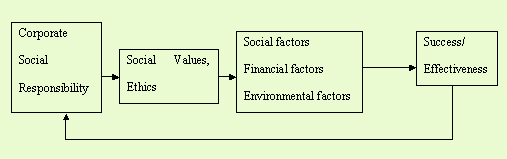
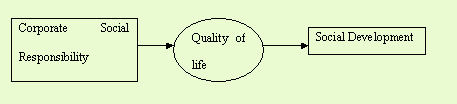
Corporate Social Responsibility (CSR) is the alignment of business operations with social values. It takes into account the interests of stakeholders in the business policies and actions. The focus on CSR is on social, environmental, and financial success of a company - the so-called triple bottom line - with the aim to achieve social development while achieving business success .


Corporate Social Responsibility - What does it mean?


One of the most frequently asked questions - and probably for all those individuals and organizations dealing with CSR issues is the obvious - just what does "Corporate Social Responsibility" mean anyway?

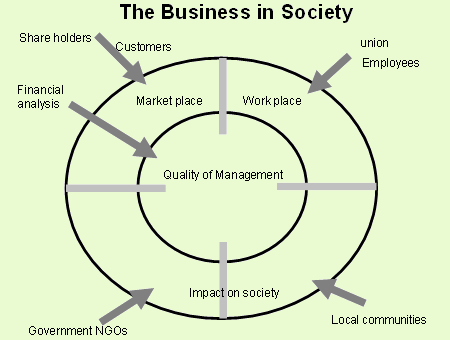
Different organizations have framed different definitions - although there is considerable common ground between them. Definition given by others refers to CSR is about how companies manage the business processes to produce an overall positive impact on society. According to Mallen Baker, CSR can be explained by the following illustration. (Mallen Baker, April 2001)


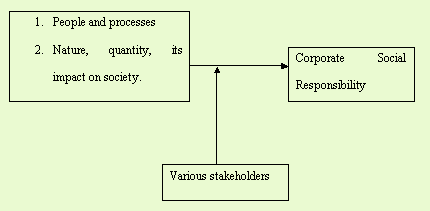
Companies need to address two aspects of their operations. 1. The quality of their management - both in terms of people and processes (the inner circle). 2. The nature of, and quantity of their impact on society in the various areas.


Outside stakeholders are taking an increasing interest in the activity of the company. Most look to the outer circle - what the company has actually done, good or bad, in terms of its products and services, in terms of its impact on the environment and on local communities, or in how it treats and develops its workforce. Out of the various stakeholders, it is financial analysts who are predominantly focused - as well as past financial performance - on quality of management as an; indicator of likely future performance.


CSR is also defined as "Making Good Business Sense" "Corporate Social Responsibility is the continuing commitment by business to behave ethically and contribute to economic development while improving the quality of life of the workforce and their families as well as of the local community and society at large".

Another definition is CSR is about capacity building for sustainable livelihoods. It respects cultural differences and finds the business opportunities in building the skills of employees, the community and the government" "CSR is about business giving back to society".

United States has defined CSR more in terms of a philanthropic model. Companies make profits, unhindered except by fulfilling their duty to pay taxes. Then they donate a certain share of the profits to charitable causes. The European model is much more focused on operating the core business in a socially responsible way, complemented by investment in communities for solid business case reasons. Because

1. Social responsibility becomes an integral part of the wealth creation process - which if managed properly should enhance the competitiveness of business and maximize the value of wealth creation to society.

2. When times get hard, there is the incentive to practice CSR more and better - if it is a philanthropic exercise which is peripheral to the main business, it will always be the first thing to go when push comes to shove.

Corporate social responsibilities therefore has to be understood within a Systems perspective. The approach has been discussed in Module I

* Click here to know more about the Systems approach. (Satsangi's paper)

Social Responsibility of Technocrats


Khan and Iqbal (1990) proposed that the basic philosophy of progress in our country is the dream of a socialistic pattern of society. There is general consensus upon the goals envisaged in our planning i.e. a rapid rise in the standard of living of the common man. It is also accepted that this rise in material prosperity can be brought about only in a technological milieu of rapid industrialization and instant communication. Such a scenario will naturally put a great responsibility on the engineers for it is they, who apply their knowledge and judgment for the optimum utilization of avail, able resources to accelerate the pace for progress and prosperity. To shoulder this immense responsibility the engineers will need to be prepared to face the challenges of future development in technology.

It is estimated that the progress made in science and technology in the 20th century is more than the progress made in the entire history of human civilization. The engineers will therefore need to keep a clear vision of the future trends in technology.

In today's fast moving technological flux it is dangerous to make any prediction for the future. Nevertheless certain trends can be safely identified.

First the world is rapidly shrinking. More and more people will be travelling utilizing faster, safer and better systems. This will usher in an era of novel and bold technologies e.g. super fast trains, supersonic jet, water transport system, traffic system organization etc. Computers, telecommunication, satellite and remote sensing techniques and a wide array of information technology will be commonly available.

The teaching and learning methodologies will also undergo major changes both in outlook as well as in implementation. Today students spend a lot of their valuable time in rote learn and cramming raw data in their minds. The difference between information knowledge and wisdom is not appreciated by the educationists. With the advent of computers and easy access to information technology there will be less need for cramming and more time and effort will be spent on thinking and analyzing.

Faster communication and information systems will become a powerful vehicle for transmission of ideas and for interaction among people in distant place. In the words of Arthur C. Clarke "ours has become the last century of the savage. For all mankind, the stone age is over".

In several fields e.g. agriculture, chemical engineering, biotechnology new research findings will usher an era of unprecedented progress and prosperity. Mankind will no longer suffer pangs of hunger nor the scourge of deprivation. Green revolution, wonder drugs and general abundance of material goods will benefit everybody and not just the elite. In short in each and every area of human Endeavour technological progress will bring in far reaching developments.

But this will also add to the responsibilities of the technocrats and managers. In such a technological milieu it will be essential that all system work in perfect harmony. The penalty for any inefficiency and incompetence will be severe and the breakdown of any system will wreak untold misery on the people. The recent Bhopal Gas tragedy is a powerful reminder to the technocrats and the managers that human attitudes will need to be upgraded corresponding to the progress in Science and Technology. Even in the developed countries e.g. USSR, U.S A. similar accidents happen with a disturbing frequency. The irony is that many of these accidents go unreported and thus opportunity for learning valuable lessons and building a data bank on case histories is lost.

Sampath (1989) has discussed the concept of Corporate Social Responsibility of Scientists, technologists and managements

* For more details about this paper please click here