| Some initiatives in this direction: |
To enforce stringent safety measures in the factory, the Factories Act is being amended. Efforts are also being made to strengthen the factories inspectorate by inducting/training of personnel for dealing with the hazardous industries. The Motor Vehicles Act is under review for incorporating provisions to enforce special measures during transportation of hazardous substances. The Environment (Protection) Act, 1986 has also the provisions for enforcing preventive, regulatory and abatement measures concerning hazardous substances.
| Pesticides and DDT: |
Use of pesticides like DDT for agriculture and public health program
has been a debated issue because of high concentration of DDT detected
in, food stuff and human tissues. Like many other countries, a policy
decision has been taken in India too, to ban the use of DDT in agriculture.
However, for public health program, there, is yet no suitable substitute
available, although efforts are being made for integrated pest control
and search of alternative chemicals
| Municipal Wastes: |
Municipal wastes are source of major environmental threat. This results in Chronic Toxicity. This calls for minimizing wastes, Promoting Environmentally Sound Waste Disposal and Treatment, Data and Information, International and Regional Cooperation and Coordination, , Financial and Cost Evaluation, Human Resource Development, Capacity-Building, Maximizing Environmentally Sound Waste Reuse and Recycling,
| Other sources of pollution |
Emissions and Sequestration from Forest Biomass, The Greenhouse Effect and Climate Change have drawn attention of policy makers. Issues in atmospheric science are related to green house effect. Impacts of Biomass combustion, flower power, and phenomenal response in trees are affected.
Global warming and greenhouse policy issues need new Strategic Imperative. Global warming has impact on global ecosystem and response of developed countries like Netherlands, Japan; New Zealand has been profound in terms of developing global warming and response of developing countries suggest various ways of managing the issue such as Global Chemical Pollution, Potential Impact, Its Collective Judgment, What was decided at Rio, Abatement Commitments, Least-Cost Emission Reduction etc. managing global warming needs international co-operation for growth of all countries.
There is also a need to evolve methodological designs and a Global Energy Efficiency Strategy.
In this greenhouse effect, ozone depletion and global climate are related to Carbon Dioxide and Plant Growth which have an impact on Ecosystems; Major Related Environmental Problems are Greenhouse Gases and Climate, Effects of Climatic Changes, Global Change in the Limelight. Global warming also shows its effects on Oceans, Coastal Effects (Tide, Surge and Waves), Wind Effects and Sea-Level Rise.
Ozone pollution, ozone hole and risks inculcate the following features Chemical Processes Controlling Stratosphere Ozone, Fire Protection, Water Mist Technology and the studies of the Antarctic Ozone. Climate change and ozone depletion call for understanding towards Action on Climate Change, Rain Forests: Drosophila can Monitor Habitat Change and International Environment Education Programme
Pollution and marine environmental health includes marine pollution, includes Oil, Crude Oil and Petroleum Products, spreading Evaporation and getting mixed into marine environment. Oil Pollution also gets affected by Shipping Accidents, Tourism and related environment all lead to degradation. Marine and coastal zone utilization is also important in this regard. Protecting marine environment and ocean resources is a challenge as it involves Sustaining Living Marine Resources, Marine Environmental Protection, Sustainable use the Conservation of Marine Living Resources of the High Seas, Sustainable use and Conservation of Marine Living Resources under National Jurisdiction.
However, generally it is the long term impact of industrialization in terms of resources depletion which is a matter of considerable current and future political significance. As a general rule, industrialized societies consume physical and energy resources at the expense of non-industrialized societies. To put bluntly, the cheapest and most readily available resources have already been utilized by the rich industrialized countries and will, in general terms, never be available for use by the non-industrialized countries, who may wish to industrialise. The political significance of this needs no stressing but relates closely to the prospects for achieving a genuine new international economic order.
| Energy Management and Development |
Energy plays a vital role in the socio-economic development of a nation. The developing nations face several financial, technological and resource crisis to meet the energy demands of increasing population that has caused serious concern to mankind to seek various alternatives such as non-polluting renewable resources. Through proper planning and management of these renewable energy sources, one can thereby promote sustainable economic growth and hence restoration of environmental quality.
Modern society is greatly influenced by the changes brought about by technological revolution. Energy is a major factor responsible for changes in the very fabric of social structure and cultural values. Energy impinges on poverty jobs and incomes, access to social services, gender disparities, population, agricultural production and food scarcity health and land degradation, climate changes, environmental quality economic and security issues. It is estimated that a large proportion of population in the developing nations are without access to electricity and use traditional fuels such as fuel wood, crop residues and dung for cooking and remain deprived of benefits of modern energy.
The depleting non-renewable energy sources have caused serious concern to humanity to seek various alternatives such as non polluting renewable resources. The inability, of the developing countries to invest in capital intensive power projects and non availability of appropriate technology is a major factor in limiting, the economic growth. In the developing countries, there is a large scope for efficiency improvements in the use of biomass for energy in industry and growing interest in introducing modern steam turbine combined heat and power (CHP) technology. Sustainable energy strategies should take into account the following considerations.
- Ensuring access to modern energy for all.
- Need for indigenous capacity building. Focus on energy services (rather than mere energy consumption), particularly for the satisfaction of basic needs.
Introduction of mix of "cleaner" centralized sources (including the next generation of fossil fuel using technologies), centralized and decentralized renewable sources and efficiency improvements.
The energy crisis has shown that for sustainable development in energy sector, we must conserve the non-renewable sources and replace/supplement them by non polluting renewable sources. The renewable ones are more or less pollution free, environmentally clean and socially relevant.
Public participation in the formulation and implementation of the energy plan is highly desirable to promote public support for agency actions and to ensure that no major omissions or in accuracies occur in the planning process. The key to successful public participation program is effective communication of the goals and activities of the management agency and feed back from the individuals and organizations to agency decision makers. To promote effective communication, the management agency should present the information in a timely and appropriate manner and should be open and receptive to criticism.
Local governments and community groups are also best able to identify and define local problems and to assess the local potential for energy conservation and development of indigenous non-renewable and renewable energy resources. Further, the local governments tend to have higher level of citizen accessibility, familiarity and accountability to provide the support and trust necessary for the development of ative and new programs. For the formation and implementation of community energy plan can be adopted in other developing nations with suitable modifications.
Energy policy is also a means of empowering Development, Natural Gas, Solar and Wind Energy, Biomass are important Energy Strategies, Fuel Substitution Scenarios emphasizes on Roles, Costs and Benefits of Policy Options. However, as discussed in the section on air pollution, fly ash is one of the pollutants generated by energy system.
Control of pollution
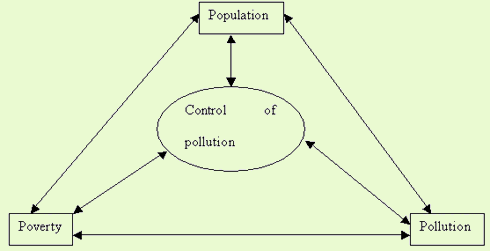
The three P's - population, poverty and pollution are inter-connected. We have to meet the basic needs of our growing population (stabilize its runaway growth), eradicate poverty and control pollution, Development based on environmentally sound principle is development and pollution controll are not mutually exclusive for attaining a better quality of life; more often than not, conflicts are due to myopic outlook and vested interest for short term gains.
Pollution problems in our country are, to a large extent, attributed due to lack of water supply, sanitation facilities and other such basic needs. On the other hand, there are problems of pollution due to increasing industrialization. As such, unlike the developed countries, we have to carry a double burden consequent upon under-development the hallmarks of which are poor environmental sanitation, malnutrition and rapid population growth; and the added burden of problems arising as side effects of industrialization.
| Policies & measures for pollution control: |
Persuasion failing which punishment is the cardinal principle for pollution control. Many of the pollution problems can be averted if not totally avoided through precautionary measures at central planning stage. `Prevention is better than cure' is particularly relevant to pollution control. The measures being taken for prevention and control of pollution are regulatory and promotional. These include the following:
| Environmental Impact Assessment (EIA): |
Procedure has been laid down to ensure that environmental considerations are taken into account while selecting the technology and sites. Guidelines have been framed to indicate the citing criteria and precautionary measures during operation of an industry.
| Minimal National Standards for Polluting Industries: |
Minimal National Standards (MINAS) and emission limits have been laid down for polluting industries and Task Forces set up to help the State Pollution Control Boards and industries in implementation of these standards in a phased manner. The standards are evolved after consultation with experts and experience of industries wherever possible. At times, there are observations that the standards are too rigid or too liberal. Such feedbacks are useful in the sense that these will help in periodic review and refinement of standards. Minimal National Standards for effluents have been evolved in respect of following industries:
- Chlor-Alkali
- Sugar
- Fermentation
- Man-made Fibre
- Oil Refineries
- Fertilizers
- Integrated Steel Plant
- Thermal Power Plant
- Textile (Cotton & Wool)
- Pulp and Paper
While evolving industry-specific minimal national standards (MINAS) a comprehensive document on each of the industry is prepared covering numbers, sizes; geographical distribution, material inputs, processes adopted, product mix, bye-products recovery, water consumption, various waste streams, and their characterization. The document specially covers control technologies for liquid, solid and gaseous (marginal) pollutants, cost implications and particularly evaluate the cost of control as a fraction of annual turnover of the industry to ascertain the minimal national standards' for effluent. The document also suggests the polluting parameters to be monitored, the frequency and mode of sampling and the procedure for analysis. No State Boards are permitted to relax the minimal national standards. If situation so demands, the State Boards may make the effluent standards even more stringent. For implementation of MINAS, Task Forces have been set up by the Central Board in respect of the following industries.
| (I) | Fertilizers nitrogenous, phosphatic and complex |
| (II) | Cement. |
| (III) | Small pulp and paper |
| (IV) | Iron and Steel |
| (V) | Power Plants |
The Task forces are estimated with the responsibility of nationwide follow up for implementation of MINAS with the help of State Pollution Control Boards and Associations of industries:
Emission limits for Polluting Industries. Emission limits for the following twelve air polluting industries have been evolved:
- Cement
- Thermal Power
- Iron and Steel
- Fertilizer (Nitrogenous)
- Nitric Acid
- Sulphuric Acid
- Calcium Carbide
- Copper, Lead and Zinc Smelting
- Carbon Black
- Fertilizer (Phosphatic)
- Oil Refineries
| Incentives for pollution control: |
A scheme of incentive which was announced in the Budget for, 1982-83 is Depreciation Allowance at 307 on devices and systems installed by industrial units for minimising environmental pollution or for conservation of natural resources.
Under the Water Cess Act, it is provided that where any person or local authority liable to pay the Cess under Cess Act, installs any plant for the treatment of sewage or trade effluent, such person or authority shall from such date as may be- prescribed, be entitled to a rebate of 70 percent of the Cess payable by such industry etc. Thus, any person or local authority may obtain rebate at the rate of 70 per cent of the actual Cess on the installation of pollution abatement devices. The financial institutions like IDBI, IFCI, and State Financial Corporations also give loans at lower rate of interest.
| Environment and Ecological Problems: |
During the 50 years of Independence, there has been a spectacular progress in science, technology and development. Food grain production has increased from 50 million tons in 1950-51 to over 192 million tons in 1996-97. Literacy rate has gone from 18.35% to 52.2% (as per 1992 census) and life expectancy from 31.10 yrs to 62 yrs. GDP has grown from 3% to 7%, but all these achievements come at a price. The question that needs to be addressed is will these achievements be sustainable in the years to come? 4.92 million hectare of forests has been destroyed for the expansion of agriculture, construction of dams and other developmental projects between 1950 and 2005. Every year, there is a loss of 1.5 of forest cover and 12000 million loans of top soil owing to surface run off. Due to water logging and salinity, about 36% land was damaged. It is difficult to measure the loss of social and cultural diversity and the communities and families break up that arise due to displacement of people from the project area.
| Globalization and Consumerism: |
The threat to environment and ecology through deforestation, pollution and indiscriminate industrialization is a hard reality, but globalization has created a new culture, MNC's have brought with them the concept of consumerism, which is responsible to some extent, for the mismatch between means and ends. There has been a shift from "preservation and conservation" to "use and throw". The rich and upper middle class have adopted this lifestyle of global consumerisms. The policy of globalization and liberalization has increased the volume of international trade. But more trade means, more consumerism, more transportation of good around the world, more fuel and energy used, resulting in more pollution and degradation of the environment and ecology.
| Environmental Protection: |
The protection of our environment is one of the greatest challenges in industrialized societies. This challenge is addressing politics and economy as well as technology and research. It is clear that the various problems in environmental protection, environmental planning, research and engineering can be solved only availability of comprehensive and reliable information. Basic state and dynamics of the environment are described by biological and socio-economic data. This data is time and space dependent and addresses past or current states. The processing of this data and the production of information on the environment, on its stress factors, and on natural influence mechanisms are fundamental for any kind of environmental planning and preventive measures. Therefore, environmental problems solving is largely based on information processing activity handling wide range of environmental data.
| Environmental information system: |
In the recent years, environmental information processing has focused on the following trends:
1. Environmental monitoring by means of remote sensing and the combination of data form all over the world.
2. A policy for sharing and integrating environmental information across political, technical and organizational boundaries making wide use of Internet technology.
3. Advanced model-based data analysis techniques, shifting the focus form data to dynamic system structure.
4. Industrial applications of environmental information processing aiming at higher ecological efficiency of the economic system.
Information processing in the environmental domain has been lacking a sound conceptual and scientific basis, since there has not been a significant research in this special domain for a long time. This is certainly not only a matter of applied informatics, but an interdisciplinary task where many scientific disciplines should be involved (e.g. geo and biosciences, environmental engineering, economics, law, measuring technology, management sciences, etc). On the other hand the growing field of environmental information processing is a great challenge to informatics methodologies and their applications. Few years ago a new discipline emerged, named as Environmental Informatics.
There is a wide range of environmental information systems in industry, public administration and science which can be classified based on the nature of the information and type of processing. This classification introduced by Page and Hilty (1995) includes.
 |
Monitoring and control systems |
|
Conventional information systems |
|
Computational evaluation and analysis systems |
|
Planning and decision support system |
|
Integrated environmental information system |
The term Environmental Management Information Systems (EMIS) refers to organizational technical systems for systematically obtaining, processing and making environmentally relevant information available in companies. In contrast to general or supra-company environmental information systems the tasks of EMIS are not confined to the environmental domain, rather they are to be understood as building blocks for more complex management applications system which serve company purposes.
The starting point for the development of EMIS in past years was not only the increasing internal need for information e.g. for taking into account legal regulations in the frame of company environmental protection but also of the external demands made on companies for information about environmental damage caused by their products and production processes.
The new discipline of environmental informatics began emerging in some countries about ten years ago with the aim of contributing to the development of a sound conceptual basis for environmental information processing in a scientific manner. However, environment Informatics does not see itself as a pure supportive discipline providing environmental sciences with computer tools. Much more, it has to offer a wide range of powerful proven methods for informatics for complexity reduction and problem solving which can also be useful in the various environmental domains.
In environmental information processing there are many different heterogeneous data structures and information sources such as text data on environmental laws or research projects, measurement data from monitoring networks, structural data on chemical substances, formatted engineering data on environmental technology, just to name a few. In particular, environmental data is often geographically coded, i.e. information pertains a to a particular point or region in space. The represented data objects are often multidimensional and have to be described by means of complex geometric shapes (e.g. polygons or curves). Also processing of empirical data with statistical methods as well as vague, uncertain and incomplete information is a major concern in environmental informatics.
A comfortable user access on heterogeneous distributed environment databases and information systems via computer networks has to be supported in this context. Metadata access is crucial for user orientation. Environmental modelling is well established in the environmental field and finally environmental data must be presented and evaluated in domain of overlapping multidisciplinary context.
On this background, environmental informatics has to focus on a number of main issues thus; complexly structured heterogeneous databases and distributed information systems are investigated. Meta data or special Meta information systems, as well as all kinds of user assistance are required for these heterogeneous user groups in large scale environmental information systems, spatial information processing aspects of geometric data structures and algorithms, as well as modern geographical information systems (GIS) have to be considered. Knowledge based qualitative concepts being of relevance in dealing with uncertain, vague and incomplete environmental data has to be visualized with powerful scientific visualization approaches. Concepts and architectures for mathematical analysis and modelling software are required for computerized statistical analyses as well as for environmental modelling and simulation. Beyond that, there is the key issue in Environmental informatics of integration of data, information, models and knowledge form various distributed sources in the environmental sector. During the last decade a many communities were formed in to deal with environmental information processing on the scientific level.
|
|