| Role of Humanity in the Control of Pollution |
Man is one of the ecologically dominant species. He can complete and exert greater influence on the habitat and on the other associated living components. Human ecological dominance is because of his anatomical and mental characteristics. Man has recognized the importance of his environment informing the most important organisms - the biologically inhabited part of the earth. Recently the study of ecology indicates the awareness toward pollution. There are two types of pollution - first - natural pollution can be treated or solved by scientific efforts and inventors, but the mental pollution cannot be treated by science. The whole world is facing the problem of terrorism, nepotism, favouritism; even the super powers are terrorizing the developing world. In the name: - of defence they are exploiting the whole human race. There is a great crisis in the civilization. Civilization is on the brinks of annihilation. A hundred thousand years or more ago our species inherited from the past not only its bodily equipment dominated by its subtly elaborated brain, but also highly charged emotional centres and all the ancient cultures in the unconscious mind. Man emerged bringing with him of hate, rage and anger together with love and the joy of life in their simple animal form.
Freud speaks of two basic instincts. Eros and Thanatos, the destructive instinct. The aim of the first is to establish even greater unities and to preserve them these in short to bind together, the aim of the second, on the contrary is to undo conations and so to destroy things for this reason it is the death instinct. So long as power and success are worshipped, the military tradition in its modern form of mechanical in humanity will flourish. The existence of civilized communities is impossible without some element of force, since there are criminals and men of force, since there are criminals and men of anti-social ambitions who, if unchecked, would soon cause a reversion to anarchy and barbarism.
The world today faces a gravely stern challenge stern challenge that assumes a variety of features. There is the material and economic problems arising out of widespread social inequalities. The root cause of all the unrest is the fact that the world today is in a state of spiritual and moral bankruptcy. Moral recovery is essential. Moral recover creates no recovery is essential. Moral recovery creates no crisis but - confidence and unity in evening phase of life. We need a morality based upon love of life, not upon repression or prohibition. A man should be regarded well if he is happy, generous and glad when others are happy. It is necessary to instil rational attitudes towards ethical questions instead of the mixture of superstitions and oppression non-prevailing.
The ideal world with free people envisages a community of nations, to be governed by a compassionate impulse of peaceful-co-existence, and a rule of law which permit each individual nation to select and follow its own peaceful way of life without infringing on the right of other nations. India, a country of non-violence still believes that the world of today is a far cry from its ideal. For building superstructure about this framework man needs a Buddha life compassion and Christ like a version for violence? We need a spiritual revolt against the materialistic outlooks of our age. The relief is to be sought in the teaching Buddha, Jesus and Gandhi. Our age is a critical one, which is to be met not with aggressive forth in the ultimate triumph of human ideologies of love, compassion and peace over these of the political snobbery and diplomatic robbery.
The two-fold task is to determine which moral assumptions to make, ie, what empirical and moral beliefs should be accepted, which are belief-worthy. In brief, systematic scientific inquiry and theorizing are necessary to achieve one of these goals, and systematic ethical inquiry and theorizing are necessary to achieve the other. But these tasks are not unusual, esoteric, or merely academic ones. For example many have pondered the question of whether, John. F. Kennedy or Martin Lather King Jr, Prince Phillip, Lady Diana or Eleanor Roosevelt etc engaged in extramarital affairs and if so, whether they deserve serious blame for doing so. In other words, familiar discussions involve trying to determine facts and relevant normative principles.
Sometimes that which seems exclusive or controversial is the relevant
moral principle or assumption. For example there is much dispute over
whether non human animals have rights, and if so, which rights and so
on. Similarly, should we think that human fetuses, or a dult humans
in permanent vegetative states, have rights? Should we think that above
all we should do what is "efficient" (for whom)? Do we have
duties to future generations - of humans of scientist creatures, of
the biota? Is it wrong or a terrible wrong to allow a species (or a
subspecies) to become extinct - or cause it to become extinct - even
if it is the human immunodeficiency virus (HIV)? However, there is a
great deal of exaggeration about how much distinctly "moral disagreement"
there is further; we may question the pessimistic assumption that such
matters are inaccessible, inscrutable and son. In fact, much so called
moral disagreement derives from empirical or scientific disagreement.
For example, In 1980's some held the normative view that those "with
AIDS" (those who were HIV infected) ought to be isolated (incarcerated)
on islands or in camps; others took the contrary view.
HARM AND BENEFIT: Most negative moral principles or judgments seem
aimed at preventing harm to members of one species, Homo sapiens. For
example compare the following:
It's wrong to kill.
Its wrong to steal.
It's wrong to break promises.
We ought to get regular medical check ups
One ought not to smoke
We ought not to drive 85 miles/hr in school zones.
Most traditional moral outlooks and theories suppose that only harm and benefit to humans is morally significant - deserving weight in decisions about what ought or ought not to be done (moral or normative decision making). Aside from the question of whose harm or benefit 0is morally relevant, the nation of harm and benefit need to be exhibited. The nation of harm can be explained as:
Premature death (often premature, permanent cessation of consciousness,
whether or not accomplished by permanent cessation of all bodily functions).
Pain (ranging from agony to frustration) and Non fulfilment of wants:
or desires: Those "States of affairs" that we call "bad"
or "undesirable" tend to involve one or more of these three
conditions. The expression of frustration of desire may refer to pain
or non fulfilment of wants or desires. What's the difference? One can
have one's desires blocked and not fulfilled without knowing that this
is the case: For example one wants to beloved by one's spouse but is
not, and is ignorant of the fact. In contrast, we often experience unpleasant
mental states-depression, sorrow, anger, worry or frustration because
we are aware that we did not get what we wanted-the job, affection,
a raise, attention, recognition, a good grade. Pain too may be a by
product of what we believe and hence it may be rationally assessed.
Is there a presumption against harming whatever beings are capable of suffering harm? A number of important matters must be kept in mind. One is that there are different forms and degrees of harm. It is one thing to be vaccinated with a needle and another to be burned alive. Second, it is one thing to discuss whether harm is a bad state of affairs as such and another to discuss the justification of imposing harm on another individual (or collective entity, ecosystem etc).
Situation that are "morally difficult" tend to be the one's in which all alternatives (including doing nothing) involve causing, or allowing, harm to some one. These are "conflict situations" and it is in this content that "moral dilemmas" arise. The situation may be naturally describable as the one in which the conflict concerns one harm versus another or alternatively, a harm versus a benefit. For example "trade offs" - farming Vs habitat preservation, industrial growth Vs the halting of the build-up of greenhouse gases, use of the oceans as sinks for wastes and maintenance of coral reefs and sea life, use of the air as a sink and having air fit to breathe. Some of these conflicts pit human life against human life, human life now Vs that of future (human) generations, or human life against that of non human fauna or flora.
In Contrast, many environmental disputes are complex for a number of reasons:
- The individuals affected are "non-standard" such as spotted
owls, pandas, krill.
- Rather than individuals, the focus may be on, say ecosystems
- The individuals may not exist (such as the future generations)
- The harm is the cumulative result of the acts of many individuals
over along period of time (compare forests dying from air pollution,
rivers dying from agricultural run offs of fertilizers, pesticides,
or dioxin from paper mills).
- The occurrence of actual harm is a matter of some probability.
Harm resulting from the existence of stocks of nerve gas, stocks of deadly plutonium, the storage of other forms of tonic wastes, the effects of substantial global warming, and the likely dire consequences to be associated with the probable increase of the world's population to 10 or 12 billion people in the 21st century.
| GREEN PHILOSOPHY |
Images of Nature and Paradise, The Concept of "Elsewhere",
Gaia Hypothesis, Values and Preferences, Why Satisfy Preferences ?,
Has the Efficiency Criterion A Basis in Utilitarianism ?, Do We Consent
to the Efficiency Norm in Public Policy, Markets, Efficiency, and Choice,
The Good Society, The concept of Community, Eco-Spirituality.
| POLITICAL ECOLOGY |
The Right to Environment Defined, Environmental Rights and International Refugee Law, Intergenerational Rights and Obligations, Representation to Future Generations, Environmental Racism is a fact of Life, Environment Justice Movement, Environmental Racism and Radioactive Colonialism, Eco-justice, The Movement Problem, Environment Justice: Fighting for Life, Contemporary Law on Indigenous Rights, Human Rights.
| ENVIRONMENTALISM |
Eco-movements, Global Eco-movements, Green Teens, Greening from the Roots up, Managing Fragile Ecosystems : Combating Desertification and Droughts, Managing Fragile Ecosystems : Sustainable Mountain Development, Alternative Dispute Resolution, Blunt and Fragile Instruments, Justice between Peoples - Justice between Generations, Possibility of a Plutonium Economy, The Expansion of Environmental Law and Policy, Green wash, A Brief History of TNC Response to Environment Problems, Green wash Begins, The Green washing of Corporate "Culture"
 |
 |
|---|
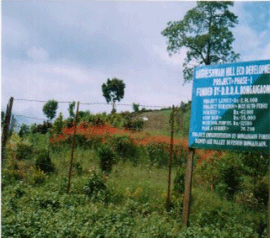
AFORESTATION AND INCREASING GREEN COVERS WILL ALLOW US TO MAINTAIN A BALANCE IN OUR ENVIRONMENT
| INTERNATIONAL UNDERSTANDING OF ECOPHILOSOPHY |
A "No Regrets" Environmental Policy, Trends in Developing Countries, Reluctance to Change Lifestyles, Earth's Wake-up Call, Right to Health, Right to Food, The Democratic Environment, Human Rights and the Environment, Human Rights and Eco-justice, Distributing Sacrifices for the Future, What Distributive Justice Entails, The Poverty Connection to Environmental Policies
| ECOLOGY AND HUMAN DESTINY |
Scientific studies on Ecology, both at global level as well as regional
level, emphasis the crisis of space, clear air and water. To top it
all, our ever increasing need of energy is being regularly published
since about half a century. The picture of human destiny that one can
construct from these reports is indeed a gloomy one. We are finding
more and more scientists joining this club of speculators for prophesying
the fast approaching dooms day.
There is a triangular relationship exists between
(1) Population density,
(2) Economic technological intensification and
(3) Increase in social complexity.
These 3 variables occupy the corners of an equilateral triangle and
ecology is the circle that pusses over these three points of the triangle.
A slight increase or decrease of any of the three sides of the triangle
will require the adjustment of the other two sides and also the ecological
circle. This explains how population increase at once requires increased
exploitation of the subsistence base and also in giving rise to increase
social complexity. It is but natural that the subsistence base will
constantly demand new technology and every new technology will again
require re-adjustment of the social sector. Interestingly, when a technology
is grafted from an exogenous source within this triangle of culture
dynamics the society is not always able to internalize it. That means
a social re-adjustment and a corresponding ideology to govern it does
not evolve.
The fourth sector which holds the social complexity and regularizes
it is the ideological realm. To a social Scientist the ideology should
be like a barometer indicating changes in the society and hence it's
a relation to ecology. The evidence of ideology are not very easy to
construct for the early states. Early historical records have been used
by several historians to build a meaningful picture of the society.
Value loading to the concepts of chastity and virginity is one such
ideological barometer. This shows remarkable change through time to
suit changing social complexity through the ages. Use of sex to grant
favour or sexual exploitation of less privileged ones within a structured
framework is not wanting in ethnographic examples.
DISCUSSION QUESTIONS:
1. How do you define "Ethics"? Discuss components of Environment ethics.
2. Discuss "Globalisation and ideologies" of Environmental Ethics.
3. Where are we going now in terms of understanding Environmentalism
in Indian society?
4. Discuss the moral standing of ecosystems in the international perspective.
5. Explicate the Indian tradition of Prakriti and how it is being turned
into 'Vikriti ' by man's actions.
|
|