Ethics can be defined as the normative science of the conduct of human beings living in societies- a science which judges this conduct to be right or wrong, to be good or bad, or in some similar way. Ethics refers to judgments that we make about human conducts, this is a normative basis of human conduct, a collective name for human actions. It deals with human actions and standards of ethics apply to relations with environment too. These actions could be good, bad, right, moral or immoral. In this module we are attempting to throw light on the ethical paradigm of Ecology and environment.
| TOWARDS AN ECOLOGICAL WORLD VIEW |
Ethics is closely tied to cultures and human values. Kluckhohn and Strodtbeck (1961) and Erez and Early (1993) have argued that there are five basic value- orientations underlying cultures. These are:
Woodall and Winstanley (2001) have defined Ethics as "Ethics is the consideration and application of frameworks, values and principles for developing moral awareness and guiding behaviour and action". They state that at an individual level, ethics provide guidelines for a judgement and a conduct when the person faces moral dilemmas and choices, while morals are a person's "intuitive and unexamined stance" which may be outside a person's conscious awareness. At the same time at the collective level ethics represent the "values enshrined in rules" and the codes of practice guiding behaviour and they underlie professional and organizational life.
Kapoor (1990) emphasized on the humanistic and scientific
values in the pursuit of sciences. These explanations could be applied
to the studies related to ecology and environment too.
* Click here for a paper by Prof Kapoor
Ethics
and Ecological Wisdom
Athreya (1997) gives an outlook for business in the 21st century to
be a blend of high prospects of growth on the one hand and the serious
concern about the impact of business on society and environment on
the other. To meet the expectations of the numerous stakeholders the
organization should follow certain values from old Indian philosophical
traditions. These values are Dharma, Lok Sangraha, Kausalam, Vividhata,
Jigyasa.
| Philosophy, Dharma and Ecology |
Philosophy has travelled through many rounds. At times it attempted
to scale the most demanding high attitude paths leading to heaven.
It then became theology - the search for God. Philosophy means"Philo-Sophia
- a love of wisdom. Philosophy, particularly as envisaged by Socrates
and Plato, was also a quest for a meaningful life, for a worth while
life with in the Indian tradition, philosophy has often been pursued
as a path of "Moksha" (liberation) as a guide to human destiny.
The ideal of philosophy - as Moksha is quite close to the meaning
of the term Dharma. In India philosophical traditions environment
and nature have been portrayed as ecological wisdom, bringing happiness
and wellness to mankind.
Although Dharma has many shades of meaning its conception as a guide
on the path of right duty is quite essential. Thus, Dharma can be
conceptualized as a form of philosophy. There is a philosophical imprint
on all forms of Dharma. Dharma is conceived as something immediate,
commands from Heaven, as the voice of destiny or an inner declaration
of who we are and what is our mission. Understanding Dharma is not
a mindless process. It requires a deep philosophical sensitivity,
but not necessarily a wealth of philosophical knowledge. It requires
an awareness of the wonderful interface of human destiny and of essence
of belonging to the larger cosmos, even if its awareness is not explicitly
articulated in the individual's mind.
Dharma is one's understanding. The higher one understands the higher
is the dharma. The lower one understands the lower one's dharma. Creatures
with no understanding have no Dharma. It clearly follow that Dharma
is a result of and a comparison of understanding. Dharma is a daughter
of understanding in world which has purpose and meaning, Dharma is
meaning. Dharma is purpose without meaning and purposes without understanding
and wisdom. The higher a being you are, the more luminous is your
understanding of the subtle intricacies of Dharma - even: if it is
not a verbal understanding.
Thus it appears as shown below:

The ideas of Ecology have been around for more than a quarter of a
century. We have become used to it. We consider its ramifications
as positive namely, to have clean air, clean water, and clean soil.
But ecology is much deeper and much more for reaching than cleaning
the polluted physical environments. Ecology is healing the 3 environments
- physical, mental and spiritual. Thus, our Dharma must be extended
and deepened to include new realms.
In our times the most important tests is to clean the earth, to cleanse
ourselves from the mental pollution. Our minds are as polluted as
our bodies, as is the air, river and soil. Preserving the continuity
of the earth and the integrity of our souls are very important aspects
of our present Dharma.
Thus, Dharma acquires a distinctly green or ecological dimension.
Whatever divides us - our cultures, our tongues, our religions, our
economic system one thing that unites us is ecology - the care for
the earth, the care for the future generations, the care for the well
being of all sentient beings. It is not sufficient now days to care
for yourself, for your spiritual well being to take cure of your religious
community. You must extend this care to the entire earth for this
is dwelling, one's temple. If we lose the environment, if we destroy
the earth, we lose God and thus destroy the grounds for all other
possibilities, for becoming spiritual beings and ultimately enlightened
beings.
Hence the importance of Ecological dharma not only for the preservation
of the earth as such but for the preservation of the conditions which
enable us to became human, thus enable us to follow the path of the
Buddha or the path of Shiva or the path of Krishna or whichever spiritual
path we have chosen to follow. True prayer and true meditation in
our time becomes ecological prayers such a form of meditation and
action which helps to heal the planet, which helps to heal other human
beings, which helps to heal all other beings, including the forests,
soil and polluted rivers. This new form of ecological redemption -
is truly universal in nature.
| The Dharma of Ecological Philosophy |
Much of the present teaching of both Hinduism and Buddhism is seeded
in the past. And much of it is a repetition of old dogmas Non-attachment
is by and large a noble and a liberating principle. But we need to
re-examine its meaning in view of the importance of Ecological dharma.
We cannot be too detached from the earth - although this phrase may
alarm some orthodox Hindus or Buddhists. To care for the earth, to
work for its healing and salvation means to be attached to the earth,
though we may say that it is not a selfish attachment the meaning
of ecological Dharma calls for a new reflection on, and indeed a significant
revision of some ancient spiritual traditions, including Buddhism,
Hinduism and Christianity.
 |
 |
|---|---|
 |
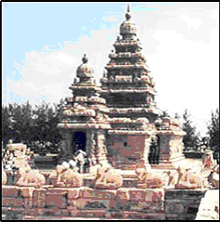
| DIFFERENT PLACES OF WORSHIP |
Ecological Dharma informs us that the ecological reconstruction,
working close to nature, bringing back labour intensive occupations
in general working for the ecological catharsis is a road that leads
us to the field of right livelihood. Wrong livelihood is destroying
people's souls and is undermining the sustainability of the planet.
What is the specific Dharma of Ecological Philosophy? It is to reassure
us that philosophy has a more important role to play, at this particular,
time, when wisdom has been replaced by information. Another aspect
of the Dharma of Eco - Philosophy is moral guidance. Traditional Philosophy
has not been able to help in combating this moral decay. Ecological
philosophy proposes new regeneration of the individual.
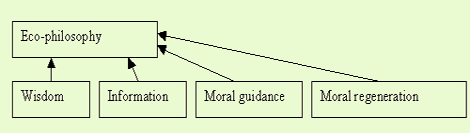 |
The moral regeneration is a most important part of our spiritual regeneration.
Perhaps the most important aspect of the Dharma of Eco-Philosophy
is to make us understand that ecology and environment are aspects
of each other, and that the pollution of environment inevitably leads
to the pollution of mind and spirit. This understanding also informs
us that the degradation of physical environment is a consequence of
the polluted minds and sullied souls.
Ecological Philosophy is in itself a form of Dharma. The dharma of
Ecological philosophy is that we must all be teachers and spread the
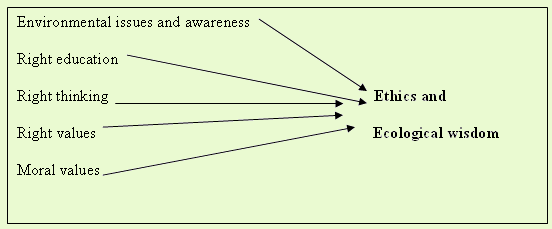
necessary light, in spite of the obstacles. Right education is the
foundation of right awareness, which is in turn the foundation of
all over thinking and action. Right education is the right implementation
of the right values. Thus the linkage looks as follows:
 |
Our times call for new resources of imagination, for new resources
of inner power to meet the unprecedented peril to the life of the
planet and to our own spiritual values. A new ecological Dharma requires
us to be passionately attached to the earth; the practice of universal
compassion in our times requires the work of the ecological reconstruction
and ecological healing. As the ecological crisis has brought about
an enormous sea of new suffering, the ecological cleansing is the
vehicle for the cessation of suffering. Ecology is the noble truth
of our times and Eco philosophy is the Dharma of our times. Hence
the message is 'Do your duty, save the environment and create conditions
for better quality of life.
Determining how we live our "private lives" is hard enough both designing a just and sustainable nation is even harder. Charles Darwin (1800-1882) author of : "On the origin of species" - is one of the most influential thinkers. To understand ethical theory and its
relation to environmental issues, certain key terms need to be noted and mentioned - such as "moral", "ethical" and "empirical". The most widespread view states that morality is about certain kinds of behaviour, such as truth telling sexual behaviour, or the use of force. But it is difficult to define "morality" or "ethics" in terms of kinds of behaviour. Listed below are some examples of perfectly clear, non controversial morals and ethics:
Rage is wrong.
Child abuse is contrary to one's duty.
We should not let people starve to death.
It is sometimes all right to lie.
Human life is very valuable.
By the way of contrast, consider the following sentences:
Rape is occurring as one reads these sentences.
Child abuse is absent in Dominican Republic.
Thousands of people have died in Rwanda.
Lying is of ten motivated by the desire to avoid feeling shame.
The claims of the second list are matters of common sense or subject
to scientific assessment. What they all seem to have in common is
that they are all claims about the world (or some small aspect of
it) and they are claims about the way world is, was or will be. Their
truth of falsity is not simply a "matter of definition"
or something to be ascertained merely from an examination of the meanings
of the words (e.g. it's raining or its not). Claims about the world
are called empirical claims. Such a use of the term "empirical"
is common practice, but other terms are often used to refer to the
same types of claims for e.g. "descriptive", "contingent",
"scientific", "positive", and "factual".
An important point is not to fight over who gets to choose the label,
but rather to be clear about what kind of claim we are assessing.
As they are characterized, empirical claims may be true or false i.e.,
being true is not a necessary feature for a claim to be empirical
claim. By "Factual Claim" some use it to describe empirical
claim. Following are some examples of empirical claims.
If the invertebrates all died, the species Homo sapiens would die out within a year.
Stories about a hole in the ozone layer are, like the story about the Holocaust, concocted to scare, decent, hard working citizens.
It takes about 500 yrs for an inch of top soil to accumulate.
Stereotypes about "eggheads" and "nerds" suggest
that those who use such terms have a certain prejudice against those
who thinks hard or thoroughly about certain matters.
The earth is about 4.5 billion years old.
We cannot ascertain the truth or falsity of many empirical claims without
scientific inquiry. Although humans have been on this planet for several
million years and "pre human hominids even longer, it is only
in the last few geological "moments" i.e. last 3 centuries,
that we have acquired certain substantial knowledge about our planet,
such as its age, of the ice ages, of prior mass extinctions, of atomic
structure, of evolution of life, of the transmission of genes, of
continental drift.
| ECOLOGICAL ECONOMY AND CONSERVATION ETHICS |
In this context ecological economy and related conservation ethics
are equally significant.
The action of human minds is fast changing the face of the earth through
industrial installations and alteration of the earth surface. The
genetic and social changes are taking place at a much faster pace.
Therefore, there is a growing need to control and correlate things
which are crucial to human health, peace and culture. Our environment
has unique resilience stability and the life support system can withstand
short term perturbations of low magnitudes but the exponential increase
in exploitation of energy rich resources and dumping in of all souls
of energy wastes and synthetic chemicals in the environment have crossed
the limit. The setback loops along the trajectory of balanced growth
are becoming increasingly large and humorous.
Despite in-depth study of structure, function and stability of several
ecosystems of the world and despite the emergence of global environmental
problems, the sole commercial attitude of developed societies has
not changed significantly. In more developed countries, people are
living an unnatural life, often quite isolated, in the company of
their electronic appliances. This tendency is permeating through to
other parts of the globe quite in proportion to the development of
material goods and services.
With the advent of mega technology and big industries, ecology has
been treated as an adversary to economy though both have common origin
from household. The judicious use of bio resources is an important
aspect of environmental conservation. Forests are the natural reservoirs
of all the wild and rare plants and animals. They have been severely
exploited in different forms. The illogical management practices not
only wipe out the valuable germ plasma from the region but also expose
the most precious resource the surface soil rich in humus and nutrients.
| ECOLOGICAL - ECONOMY AND ECO - DHARMA FOR A SUSTAINABLE SOCIETY |
Mankind is a part of nature. Ecology is the study of the structure and function ofnature. Our Earth is like a "Spaceship Earth" on which man has domesticated only 30 animals out of more than 50 lakh to 100 lakh species due to their economical importance in a given ecosystem or Earth Dharma we means we all 5 billion people along with 5 billion animals are all in a limited space with limited resources and the survival of human race now depends on rational utilization of these resources. The human body only needs limited resources but human mind (Mana) has unlimited desire.
Mind controls internal organs and body life becomes chaotic and disintegrated when mind is led by the senses, it becomes orderly and peaceful when the mind exercises control over the senses is the essence of the unpunished. A human being is complex of spirit and matter that is Atma (self) and Anatma (not-self). Depolluted mind (Selfless life) is the need of 21st century to ensure peace because selfish life-materialistic approach endangers space.
Internal organs of all human being are one-spirit, but known as mind (Mana), intellect (Budhi), memory stuff (Chitta), and Ego (Ahantiara). Whole-some mentality of a person is conducive to both self integration and social integration. Man of reasoning is the man of knowledge (Brahman) and it is through reasoning that a human being makes distinction between knower and known in epistemology, substance and attribute, whole and part in meticiphysics, right and wrong, good and bad in ethics. This world of our is a natural fact through it is "Maya" (Illusion) which means world is and not being is and not, I am and not Ecological- Economy is arealidity and in earth. Dharma historic events are in decently real through perishable (Nashwar) in this infinite world (Anant). Spirit is SWAYAMBHU (Self created), Nature is Swayambhu. It is mystery. Man's man can know it "Say Tetris a U punished". Mind is conscious, subconscious and unconscious spirit (Atma) is conscious. In the ecosystem of our Earth man came in to existence as Hindu Philosophy says" Lakh Chorasi Joon Bhugat Kar Phir Manusha De Ayo" that is man evolved after 84 species were produced. Creation of nature is spontaneously and forest is university (Chhadogya Upnishad) and food, vital breath, mind and intelligence is Brahma.
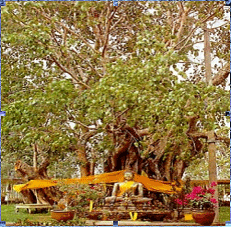
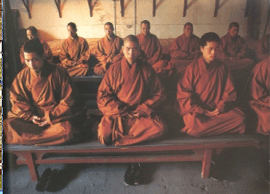
Different places of meditation
|
|