Behavioural Interference
The behaviour interference model view high density as a necessary but not sufficient condition for crowding stress.
When high density interferes with our goal-directed behaviour, we experience crowding stress.
The behavioural interference model suggests that our crowding stress will increase in proportion to the importance, we assign to the goal we are trying to reach.
In effect, more important our goal-directed behaviour, the more time, energy and the effort we are willing to exert in coping with the high-density condition and in completing our goal-directed behaviour.
| Ecological Models of Crowding |
Theories of crowding which are based on nation of social process are called "ecological" models of crowding.
John Calhoun proposes that we are able to tolerate high density in the spatial environment because our form of social organization has evolved ways off-putting "conceptual" space between people.
Crowding and Personal Control:
Negative psychological consequences of high density can be mitigated by playing some degree of personal control over it. Psychologists demonstrated that adverse psychological effects of crowding can be reduced through a strategy of gaining a sense of 'cognitive control' in the crowding situation. They suggest that people can cope with the stress of crowding if they are provided with accurate information about the likely psychological reactions to crowding.
Helplessness behaviour
Learned helplessness is a psychological phenomenon. The theory of learned helplessness which earlier was applied to environmental stress can be applied to the psychological consequences of the loss of personal control in high-density situations too. Example: Students who were unable to exert 'behavioural control' over the nature, frequency and duration of social contacts in their dormitories, in contrast to residents of dormitories where social contacts could be more easily controlled, demonstrated the symptoms of learned helplessness.
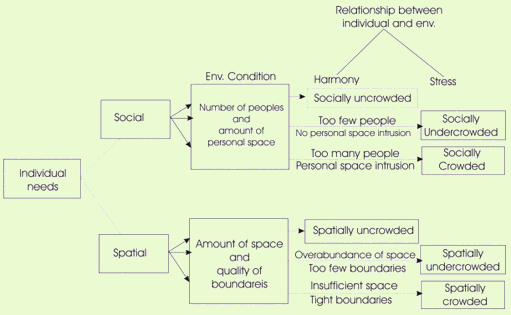
A Social - Spatial Model of Crowding Stresses
| Environmental Health Hazards Analysis and Assessment |
Health hazards associated with both military and civilian systems and equipment involve various aspects of human-environment interface. The relationship below the environment and human health has been recognized for centuries and has become even more evident as society and technology advance.
Environment is defined as all factors that are external to human body. Thus, environmental health represents the relationships of the human-environment interface. When all environmental factors are considered collectively, they are considered to be macro environment.
Other, more specific human-environment interfaces, such as workplace exposures, in door air quality issues, confined spaces, and others are considered to be microenvironment.
When one assesses enwall health impacts, all exposure sources should be
considered. Therefore, the risk assessment process:
- Hazard determination
- Dose-response assessment
- Exposure assessment
- Risk characterization
Should include the exposures from all microenvironment.
Many products that we use in our society can have potential dangers that may be inherent in their composition or may result from the way that they are used, stored our disposed. For Example vehicles that use combustion engines and fossil fuels can generate a variety of potentially dangerous exhaust products such as carbon monoxide. Some vehicles (e.g. large trucks, aircraft etc) also can exit high noise levels that may damage hearing. Even the clothes we wear may be treated with chemicals that can be harmful under certain conditions (e.g. pesticide impregnated military garments) or they may be a factor associated with the development of temperature-related diseases.
When military equipment and systems are developed or acquired, concerns
about many enwall health issues, may converge. All of the military services
- army, navy, air force and machines-have formal programmes to develop
and acquire equipment and systems. For example the U.S. Army has consolidated
the health aspects of HIS (Human systems integration) program under
a single centralized program, the Health Hazards Assessment
(HHA) program. The HHA program is a part of the army's preventive Medicine
Program: therefore it applies a public health perspective to prevent
soldiers from being exposed to harmful levels of chemical, physical,
and biological agents.
There are nine (9) health hazard categories typically addressed by the HHA program:
Acoustic Energy
The potential energy that transmits through the air and interacts with
the body to cause hearing loss or damage to internal organs. It refers
to the effects that result when people are exposed to steady state noise,
impulse noise and blast - over pressure.
Biological Substances
The exposure to micro-organisms, their forms and enzymes. The
organisms include poisonous plants and animals and a wide variety of
human pathogenic micro organisms and or their associated forms. A biological
hazard may produce disease, death or a debilitating condition when an
agent is introduced to a susceptible host in sufficient quantity to
cause an adverse effect. It may be introduced through suggestion (e.g.
contaminated food or water), inhalation (e.g. viruses, mould/fungi spores),
skin contact (e.g. poison ivy or oak), or injection (et snake bit or
bee sting).
Biological hazards may come from a broad spectrum of sources that may include micro organisms (e.g. bacteria, viruses, rickets, moulds etc), parasites, venomous insects, and other animals (e.g. replies, amphibious, marine animals etc, insect vectors and poisonous and toxic plants).
Chemical Substances
The hazards from excessive airborne concentrations of tonic materials. Exposure occurs through inhalation, ingestion, and skin and eye contact.
Chemicals are prevalent and ubiquitous in the environment. They can occur naturally in the environment: however, many are man-made (synthetic) and introduced into the environment through anthropogenic ways. As defined for the HHA Program, the chemical substances health hazard category focuses on toxic liquids and solids and excessive airborne concentrations of rusts, gases, vaporous fumes in particulate matter. People or the environment may be exposed to potentially harmful chemicals during the development, use, storage and ultimate disposal of military equipment. People can be exposed through several routes to include inhalation, ingestion dermal (skin) absorption or direct injection (pare terminal)
The sources of chemical concerns typically addressed by HHA process include both military. Unique and non-military unique operations and equipments. Examples of such sources include wheeled and tracked vehicles, vessels, rockets, missiles etc), smokes, and obscurants, chemical agents and maintenance and logistics operations.
Oxygen Deficiency (Ventilation
The displacement of atmospheric oxygen from enclosed spaces or high
attitude. The oxygen efficiency category addresses a variety of situations
and conditions that affect the availability of oxygen in breathable
air. It includes low oxygen concentration as they relate to confirmed
spaces, enclosed spaces, and ventilation needs.
An oxygen-deficient atmosphere is an atmosphere that contains less than 19.5 Y. Oxygen by volume (29 CRF 1910.146). Ventilation is one of the principal methods to control health hazards and may be defined as causing fresh air to circulate to replace contaminated air
A confined space is an enclosed area that is large enough to accommodate a person's body, has limited means for entry and exit and is not designed or intended for continuous human occupancy (Schroll & Harris, 1998). A confirmed space many create conditions that can affect the nature of its atmosphere. Oxygen deficiency may occur when gases or vapors exceed their upper explosion limit and when oxygen is consumed by chemical reactions (eg resulting) or biological reactions (et biological breakdown of organic materials).
Similar to confined spaces, the military considers the health aspects of enclosed spaces. Enclosed spaces differ from confined ones in that they are designed for detail work, or occupancy for extended periods of time and are designed to receive adequate ventilation. Examples of confined spaces include but are not limited to storage holding tanks, vessels, silos, pits, sewers, pipelines, tank cars, boilers septic tanks, and utility vaults. Examples of enclosed spaces that are frequently encountered in the military include mobile vans, shelter, crew compartments, and vehicle-cabs.
The human body can experience oxygen deficiency effects that result from decreased barometric pressure. Reduced atmospheric pressure decreases the rate at which oxygen diffuses into the blood. Thus, people who are exposed to low-pressure environments suffer the effects of a variety of hypobaric health hazards which includes hyzone. Hypoxia can affect mental performance, judgement sleep and physical work capacity. Decompress on Sickness (DCS) also occurs at high altitudes similar to that associated with driving.
Radiation energy
Ionizing: The radiation causing ionization when interfacing
with living or inanimate matter.
Non ionizing: The emissions from the electro magnetic spectrum with insufficient energy to produce ionization of molecules.
Radiation is electro-magnetic energy that can be divided into two broad categories - that which causes matter to ionize (i.e. ionizing radiation) and that which does not cause matter to ionize (i.e. non ionizing radiation). The types of non ionizing radiation and fields include ultraviolet, visible light, interfered, microwaves, radar, television, radio waves, extremely low frequency, electric fields and magnetic fields. Ionizing radiation types are X-rays, gamma rays and cosmic rays. Ionizing radiation is electro magnetic or particulate radiation capable of producing ions, directly, in its passage through matter. Examples of ionizing radiation are alpha and beta particles. X-rays, gamma rays, neutrons and heavily charged ions.
The absorption of ionizing radiation in biological material may lead to excitation or ionization. In humans, this may be demonstrated by genetic and somatic effects. The induction of cancer is the primary somatic effect. Other somatic effects include effects on growth and development, cataract of the eye lens, life shortening fertility and sterility. Exposure in uterus may induce cancer during childhood.
Shock
The mechanical impulse or impact on an individual from the
acceleration or deceleration of a medium. Shock is a health hazard category
that has been evaluated infrequently in the HHA program. Consequently,
its concepts, hazard evaluation, risk concerns, and implications towards
soldiers have not been holly developed.
Shock, impact and impulse are terms used to describe the rapid and violent application of mechanical forces to the human body. Theses forces are characterized by short durations and high magnitudes. Impact injury may be described by the deformation of body tissues in excess of their failure limits. Resulting in destruction of their anatomical structures and more importantly, the disablement of their physiological functions.
Impact is considered to be blunt when the forces are distributed over some area of the body and do not cause penetrating injury. Indirect-impacts where the forces are generated as a result of sudden whole-body accelerations or decelerations are generally the longest type of impact with duration ranging from 50 to 250m sec. Penetrating injuries, which are produced by high-speed missiles or sharp objects, involve the concentration of forces over a small area of the body. Because of the magnitudes and durations of such forces are difficult to measure, the severely of impact is generally characterized by the energy of the striking object.
Impact to the human body may occur as a result of aircraft crashes, ground vehicle accidents. Mine explosions parachute opening shocks, landing falls, weapon recoil and other interactions between the solder and his or her environment during training or battle missions.
Temperature Extremes and Humidity: The human health effects associated with high or low temperatures, sometimes exacerbated by the use of material system. Exposure to excessive heat levels can cause heat stress, which can lead to heat strain. Heat stress is the product of an interaction, of work activity (e.g. a military vision) and environmental factors with physiological factors (U.S. Army, 1996). Work activity can be mental factors such as clothing, load carried, terrain and work mate. Environmental factors include temperature, humidity; solar load and wind space Examples of physiological factors include fitness, hydration acclimatization, rest, nutrition, medication and health. Health stress can lead to heat strain. Heat strain is characterized by one or more of the following.
Hyperthermia
Increased sweating rate (this decreases heat stroke)
Dehydration
Compromised cardiovascular control.
Increased heart rate.
Heat strain can result in hear-related injuries such as heat cramps, heat exhaustion and heat stroke. Mental and physical performance decrements can occur at dehydration levels that are higher than and/or hypothermic levels lower than those that cause injury. Heat cramps and heat rash also can develop from excessive exposure to heat.
Shelters, vehicles and clothing are examples of military material systems
that may cause heat stress. Shelters may cause heat stress if adequate
air ventilation and air conditioning are not maintained consideration
must be given to the added heat load of heat-generating equipment such
as computers, when assessing the heat stress or work spaces. Vehicles
also may cause heat stress if air ventilation and/or air conditioning
is inadequate.
|
|