| Module III |
| ENVIRONMENT, ECOLOGY AND QUALITY OF LIFE |
Ecosystem services performed free provide one most important pillar on which human life and civilization based upon. All human activity (economic) require three function from the environment. Thus, one of the important objectives of the study of Environment and Ecology is to achieve better quality of life for people. This module presents these aspects. They may relate to the following issues, from both micro and macro perspectives.
1. Raw material as energy as peter input
2. The assimilation of water
3. The maintenance of life support system (Such as eliminate regulation,
air and water purification and maintenance of genetic diversity)
Other thing being equal it can be observed that as production increase, increasing stress is placed on these three functions, leading to environment degradation. There exists enough scientific evidence which shows that human activities have already impaired the flow of ecosystem service on a large scale which if continues will dramatically alter mostly the entire ecosystem within a few dealers. Ecosystem services which are essential for economic prospecting and other various aspects of human well-being refer to a wide range of conditions and process. These service, which are fundamental to life, include (Holdren and Ehrlichain Enrich and Ehrilch 1981) things as follows: -
1. Production of ecosystem goods fishes, animal products, vegetation,
forest species fruit nutrition food, fuel, wood.
2. Generation and maintenance of diversity.
3. Mitigation of drought and floods.
4. Generation and preservation of soils and renewal of their fertility.
5. Detoxification and decomposition of wastes.
6. Pollination of crops and natural vegetation.
7. Dispersal of seeds.
8. Cycling and movement of nutrients.
9. Control of majority or potential of agricultural parts.
10. Protection of coastal shores from erosion by waves.
11. Protection on from the sun's harmful ultraviolet rays and their
impacts.
12. Provision of aesthetic beauty and intellectual simulation that lift
the human spirit.
Historically it has been found that the nature and the values of Earth's life support system have largely been ignored until their disruption or loss highlighted their importance. The most important reason behind this is that in most of the cases they are not traded on formula market (non economic goods- free good) and so do not any price rignat that can warn the hanger occurred in their supply or condition. Problem of externally and market failure. Besides lack of awareness and attention also constitute importance reason?
Due to these increasing threats there is an urgent need for identification and monitoring of ecosystem services both locally and globally as well as for the incorporation of their values into decision-making process. Environmental change is an inevitable consequence of economic progress and people's desires to improve their quality of life.
Change in environment and a various human threats
Environmental condition especially environmental change exerts great
threats on human welfare having social, economic and ecological dimensions.
It extends great influence on health, habitat, infrastructure, economy
society and culture.
Below we will discuss the environmental treats under three main heading:
Health
Food security Quality of life
Economic effect
Health
By 'environment' here we mean the physical chemical and biological setting
in which the people live in i.e. soil, air water and climate condition
not the social one (life style, food and habit). Environment hazards
to health can be classified into the following broad categories.
The first is a lack of access to essential environmental resources most
important among them being adequate and clean water, food, shelter,
fuel and air. The second broad category is exposure to hazards in the
environment. These hazards include biological agents like micro-organisms
(e.g. bacteria, viruses and parasites),which are the root causes of
the huge global problem of infectious diseases. Biological agents are
responsible for diseases like diarrhea, acute respiratory infection,
malaria, ulcers and even some forms of cancer.
Among the chemical and physical hazards, some pollutants like pesticides, industrial solvents, persistent organic pollutants are generated by human activities. There are some others, like arise or ultraviolet radiation which occur naturally in the environment and increase with human activities. It has been found that environmental changes locally regionally and globally can exacerbate both types of environment health problems. Health impact of climate change can be discussed under two board headings- direct and indirect both of which are equally important. There are both direct and indirect impacts of environment on quality of life.
Direct impact
Increase in the number and divert of heat water is the most expected
danger. This becomes more vulnerable especially in cities, which tend
to trap heat. In both New York and Shanghais it has been observed that
daily mortality rates increase considerably as soon as temperature exceed
a certain threshold limit. Besides mid latitude cities include Washington
Athens etc where the residents (mainly elderly the very young and the
poor) Who are not acclimatized to extremely hot weather are more susceptible
to heat waves among them also people with substandard housing previous
health problem lack of access to air conditioning facility are more
prone to be victims of heat. A major reason behind this is, because
ones cardio vascular system must work harder top keep the body cools
during hot weather. However the heat stress problem to lower in tropical
and subtropical cities where there exist hotter average temperature.
On the contrary a potential health benefit of warmer global temperature
is that cold related deaths are lesser.
Another consequence of global warming is missing sea level, which can adversely affect the health and well being of coastal inhabitants. This missing level incindates wealth and other low lying lands river deltas erodes beaches, intensifies flooding storm related and increase the salinity of rivers boys and ground water levels fresh water supplied sixteen of the world largest cities with population more than 10 million are located in coastal tones and coastal population are increasing rapidly world wide. Some example of low lying areas like river delta in Bangladesh, the Nile delta in Egypt or the Niger Delta in Nigeria. A recent study project that a 1 meter sea rise could inundate 17 percent of Bangladesh's total land area and displace near a point 11 million people (at current population densities WRI 98-99). Another important direct impact of climate change is its influence on air pollution profiles. Exposures to polluted air create serious threats.
Higher air temperature increase the concentration of ozone at ground level, which is a harmful pollutant and the main constitutent of smog. Ozone damages lungs tissues and causes serious problems for people with asthma and other lung diseases. Even a fairly moderate degree of exposure to ozone can cause healthy individuals to experience chest pain, nausea and pulmonary congestion.
Indirect Impact of environment on quality of life
Global warming generally increases the risk of some infectious
diseases, in particular vector borne diseases. The reason behind this
is that temperature and rainfall affect the abundance and distribution
of disease causing vectors or contagion spread by mosquitoes and other
insects, which includes malaria, dengue fever, yellow fever, and several
types of encephalitis. Other vector bone diseases include cnislosomiasis
(snake), change disease, sleeping sickness, liver blindness etc. According
to some scientists, algal blooms can occur more frequently in warmer
temperatures; specifically in the areas with polluted water, one example
related to this is cholera by organisms like giardia, salmonella, cayspordium.
Besides climate change, also affected are climate temperature, rainfall, pattern and increased carbon dioxide levels, which in turn have important effects on global agriculture and thus on human nutrition. On the positive side, high levels of carbon dioxide in the atmosphere exert a fertilizing effect on some plants by increasing their growth and reducing transpiration rates and water demand. Increase in temperature can also bring about larger growing seasons to some high latitude farming regions, increasing yield, and the range of crops .On the other ride of the case, increased temperatures and diminished rainfall can reduce soil moisture in various areas (specially in some tropical and mid continental regions) which in turn reduces the water available for irrigation and impair crop growth in non irrigated areas
In addition to this, warmer temperatures affect plant post and diseases positively the range of many insects will expand or change and new combinations of pests and diseases may emerge or natural ecosystem responds. Any increase in the frequency or severity of extreme weather event like droughts, heat waves wind storms can also disturb the predator-prey relationship, which generally check pest population.
However there exists regional difference in the way human health is
vulnerable to environmental degradation. Water borne and water borne
diseases are more common in various parts of central and South America,
central Africa and Asia. Air pollution threatens large urban areas and
mega cities most of which are in developing countries.
People in developed countries are more vulnerable to exposure to toxic
chemicals and technological accidents. However there is exception like
arsenic contamination in South Asia.
It is estimated that about 25-33 percent of the global burden of disease
is Attributable to environmental factors (Smith, Corvation, and Kjellstrom
1999). In a study it has been found that environment related premature
death and illness account for 18 percent of the total burden ease in
the developing world. (Murray and Lopet 1996). This comprises contribution
from water. Supply and sanitation 7 percent, indoor air pollution 4
percent ,vector borne diseases 3 percent ,urban air pollution 2 percent,
agro industrial waste 1 percent.
In short, final disease due to environmental change generally has more adverse impact on developing countries than on developed. This is so because developed countries devote considerable effort for reducing health threats from dirty water, poor sanitation and using solid fuels in open fires inside homes. The annual global burden on human health is estimated to equal some 312 million days and to cost world society some U.S. and 10 billion annually (G E SAMP 2001).
Food Security
Food security means being able to obtain nutritionally adequate, culturally
acceptable diet at all times through local cal non-emergency sources.
This requires both adequate food production and impact and economic
access to food at the household level, at all times to ensure a healthy
active life (VY al 2000).
Environmental change also increases the vulnerability of the portion
who are here also all nations are not equally adversely affected poorer
nation, tends to be more dependent on climate sensitive sectors e.g.
subsistence agriculture and lack the buffer resources required for survival
this is due to many factors like less developed technology and less
availability of capital non marketability etc. For example even though
it has been found that food production in Africa has declined slightly
over the past 30 year and decreased significantly in the former Soviet
Union since 1990 (UNDP, UNEP, World Bank, RBI 1998).
Economic Losses
Human well-being is inextricably linked with the ecosystem through
goods and services that the ecosystem provides. This includes both market
goods and services (e.g. food or forest product, fish etc) and non-marketed
ones (e.g. water flow regulation).
Thus any degradation or reduction in supply of environmental goods leads
to a loss of human welfare. In a study by Suehak 2002, it has been found
that U.S $10 billion a year or 4.5% of G.D.P in 1992 of these, Urban
air pollution costs U.S $ 1.3 billion a year, water degradation with
its associated health costs U.S $5.7 billion a year. Land degradation
causes productivity losses of around U.S $ 2.4 billion and deforestation
leads to annual losses of U.S $ 21.4 million.
The potential economic losses of the non-marketed goods and services
and their impact on human life are most likely to be higher than that
for marketed goods and services which can be measured.
Environmental Stress
Sources of stress could be many and human response to stress may also differ. In this section we emphasize on the issues related to environmental stress. In today's competitive world, on every second step, man comes under some stress or the other. Causes range from trivialities such as a lost book or important incidents such as major exams, but the common denominator of all such stress causing agent is the Environment itself! Through time various theories have been put forward to explain this complex phenomenon called stress. Before we look at various types of environmental stressors resulting into poor quality of life, we need to pay some attention to "what is stress?'
Some say Stress is frustrated 'fight or flight' response a basic human survival mechanism remnant of our primordial 'roots' when we would best respond to perceived dangers by either fighting or fleeting; seen in this way, stress behaviours and emotions are sometimes regarded as problematic inappropriate responses to threatening situations in modern civilized society, people who consider stress in the negative sense consider it to be the uncomfortable gap between how we would like our life to be and how it actually is.
|
Environmental stress has been defined formally in many ways:
The adverse effects on human physical and psychological well-being caused
by external factors such as noise, vibration, extremes of temperature
and danger. Stress or systematic stress can be defined as the non-specific
response of the body to any environmental demands made on it.
Stress is an inevitable, invisible, unavoidable consequence of life. When looked at from an environmental point of view, it can because distress can cause disease; it seems plausible that there are good stresses that promote wellness. Stress is not always necessarily harmful.
Increased stress may also results in increased productivity - up to a point. However, this level differs for each of us. It's very much like the stress on a violin string.
In the following presentation we would like to put forward the various
aspects of environmental stress, describing first the causes, then moving
on to their effects and then finally signing off with the major methods
to cope with them!
The physical environment can often influence how the person is thinking,
feeling and interacting with others. Too much or too little stimulation
can have profound effects on the well-being of someone. For example,
if a room is crowed or noisy, anxiety and agitation may arise from the
over stimulating sights and sounds. If a room is too quiet or too dark,
similar responses may be seen.
Environmental psychologists observed that - As people become more cognitively impaired they encounter increasing problems with negotiating with the environment. It is important to know what type of environment works best for each person. Providing an area where the person feels safe and secure will greatly improve how he or she interacts with others.
Environmental Stressors
Environmental stresses could be any of the following:
Physiological stressors: These factors produce stress in human body.
These are caused due to them physical elements in atmosphere around
us. There can be many of these factors. Some of them are given below:
-
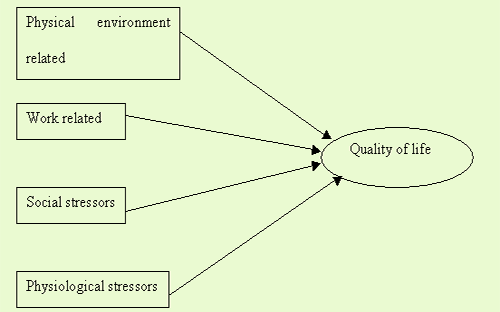 |
Physical environment related
Noise: - Noise is the sound that the listener does not want
to hear. Noise can the environment affects a person's working performance.
Surrounding temperatures: - Change in surrounding temperature,
feeling of hot or cold, can causes physical as well as mental stress
in some people.
Traffic and crowding: - Commuting in heavy traffic and meeting
the demands of driving in traffic can be a difficult task and the person
is constantly in heavy mental stress while driving.
Pollution: - Pollution (air, water) can cause a stress in humans
directly or indirectly.
Light: - Natural light elevates the mood and helps maintain a
regular internal body "clock". Deficiency of natural light
is an unrecognized environmental stressor.
Work related
Change in working environment: - If a person's working environment
is changed e.g. he is placed in between a new group of people, it can
affect its working in either positive or negative sense.
Colours: - The colour also affects on mood and energy level
of a person. It's a very individual choice and varies from person to
person that how a color affects him.
Workload: - If there is less workload than the person is used
to then it makes the person restless and the same is true if there is
more. Also if there is more work than the capability of person then
it can result in mental breakdown.
Condition of workplace: - These factors (e.g. ventilation, sitting
arrangement, and architecture or place) can have an effect on the mood
and energy of the person.
Social stressors: These are caused due to the society in which
the person is living. Some of them are given below -
- Loneliness
- Friends
- Society's expectations
- Family matters
There are many other factors which contribute to stress. But the above factors were the most common ones. These are interrelated i.e. one of the factor can change the persons attitude towards other.
Environmental stressors for students
We can understand the entire above phenomenon by a simple example.
One of the most important and simple example is college life. College
is a unique environment that has its own built-in joys and stresses.
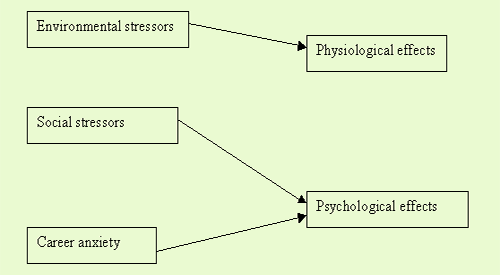
The living situation in many colleges creates a lot of stress. The
housing is often crowded, noisy, with an inherent lack of privacy and
uncomfortable chairs, desks , and beds. There are the expectations of
friends, family, and hometown high school teachers and counsellors to
live up to. There may be the stress of being separated from family,
home, and close friends the student grew up with. There is usually a
fair amount of financial pressure for college students, with limited
economic resources for entertainment, transportation, and even food
and books.
To meet academic demands, many students may start living a life of all
work and no play. They may spend all their free time in the library,
studying until later hours but not getting any better grades than do
their friends who seem to party all the time. The fact is that without
some breaks for relaxation and recreation, they do not study so effectively.
Study breaks, whether they are fun distractions like going to a movie,
a party, or a football game or going for a jog, are needed to get balance
in your life. They will renew their enthusiasm for studying.
Social stressors are common in college. There is a natural desire to
be accepted and liked by a new peer group. There may be pressure to
conform in dress, attitudes, and activities. Concerns about rejection,
failure, and inadequacy in a highly competitive environment are huge
stressors.
Another common source of stress is career anxiety. With competition
in the workplace and in graduate schools, we may think that we don't
have much time or flexibility to explore interests and get a broad education.
Getting used to living in a new area, adjusting to a different climate,
and learning our way around can be stressful as well as exciting. Going
to college is an adventure and a challenge.
The effects of stress can be broadly classified into two basic categories:
1. Physiological effects
2. Social & psychological stress
|
|