|
Diffusion is the process by which particles move from a region of higher concentration to a region of lower concentration. If the process is left undisturbed, it would result in uniform density of particles in the medium. The following points are to be noted about diffusion : |
|
Diffusive motion takes place because of random thermal motion. |
|
Diffusion takes place irrespective of whether the particles are charged or not. |
|
Diffusion of particles takes place along the concentration gradient, i.e. from a region of higher concentration to |
| |
that of lower concentration. |
| |
If the particles of the medium are charged carriers, like electrons and holes in a semiconductor, the diffusion along the concentration gradient results in a current, known as diffusion current. Unlike the drift current , the diffusion current depends on gradient of concentration rather than on the concentration itself. If the carriers are electrons, the diffusion current is proportional to  , where  is the electron density. Likewise, the hole diffusion current is proportional to  . |
| |
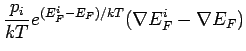
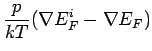
Consider the diffusive motion of holes in one dimension. If  is the concentration at  , and  , i.e., if the concentration is increasing where  is the intrinsic Fermi level and  is the Fermi level in the presence of acceptor impurities (we have dropped the redundant superscript  ). Thus |