| |
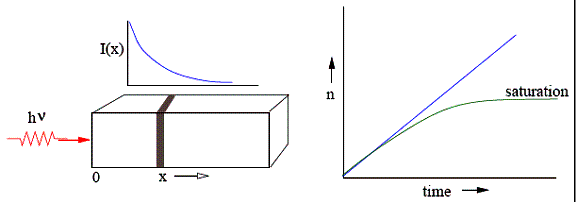
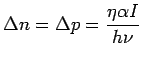
If we define  as the quantum efficiency , i.e. the fraction of absorbed photons that produce electron-hole pairs, the number of pairs produced per unit time is given by |
| |
In principle, the process of illumination will lead to a continued increase in the number of carriers as the amount of energy absorbed (and hence  and  ) will increase linearly with time. However, the excited pairs have a finite life time (  to  s). This results in recombination of the pairs. The relevant life time is that of minority carriers as a pair is required in the process. Recombination ensures that the number of excess carriers does not increase indefinitely but saturates. |