|
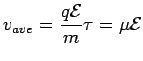
However, if  , the carriers have a net motion in the direction of the field (for , the carriers have a net motion in the direction of the field (for  ) over which the random motion is superimposed. This is known as the drift velocity . The figure shows drift of an electron in the field, the abrupt changes in the direction is due to a collision with an atom. The drift velocity is proportional to the strength of the electric field, the constant of proportionality being known as mobility. Taking the average time between collisions (called the relaxation time) to be ) over which the random motion is superimposed. This is known as the drift velocity . The figure shows drift of an electron in the field, the abrupt changes in the direction is due to a collision with an atom. The drift velocity is proportional to the strength of the electric field, the constant of proportionality being known as mobility. Taking the average time between collisions (called the relaxation time) to be  , the average increase in velocity between collisions is given by , the average increase in velocity between collisions is given by  is given by is given by |
| |
where  is the mobility of the carrier. is the mobility of the carrier. |
| |
For a semiconductor we need to replace  by by  , the effective mass of the carrier. Mobility depends on the relaxation time - the longer the interval between successive scattering, greater is the increase in incremental velocity. Likewise a smaller effective mass means larger acceleration and consequently a higher velocity. , the effective mass of the carrier. Mobility depends on the relaxation time - the longer the interval between successive scattering, greater is the increase in incremental velocity. Likewise a smaller effective mass means larger acceleration and consequently a higher velocity.
The unit of mobility is m  /V-s. /V-s. |